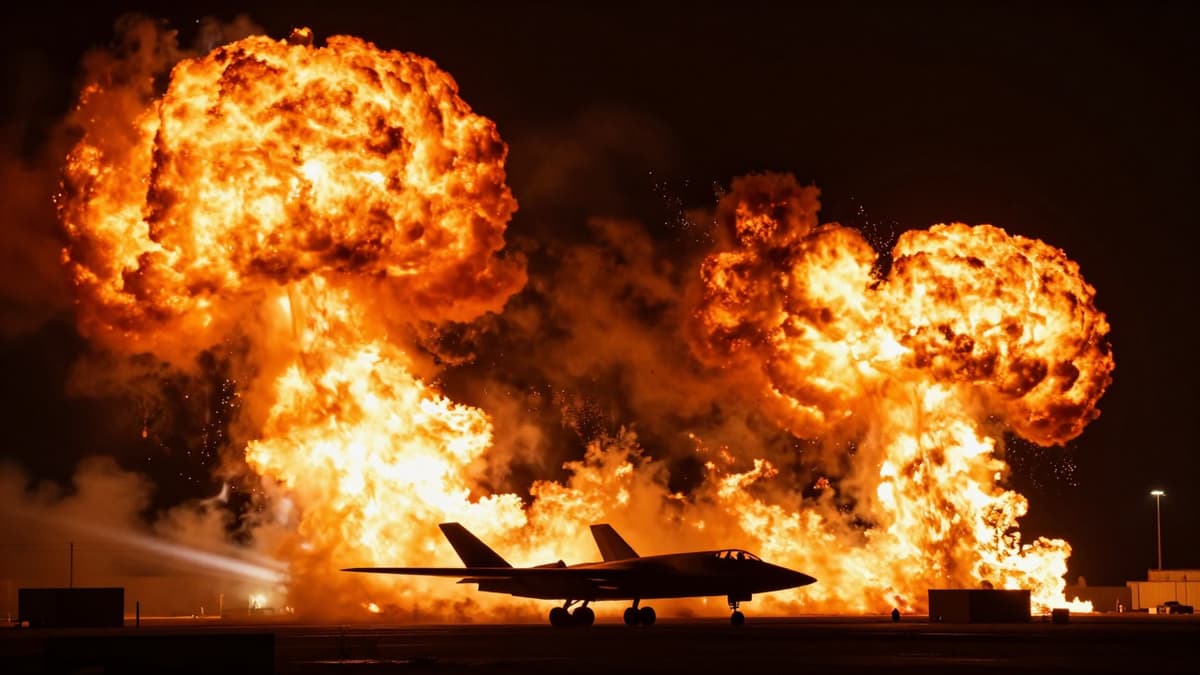
President Trump escalates military pressure on Iran, deploying advanced B-2 bombers to strike the Isfahan site. Massive explosions light up the night sky as Operation Epic Fury begins.
US President Donald Trump early Tuesday escalated his rhetoric and messaging regarding America's military campaign against Iran. He highlighted the scale of strikes carried out under Operation Epic Fury, reportedly executed by B-2 bunker busters. Trump shared a social media post showing the city of Isfahan engulfed in flames. This action follows earlier warnings from the President that Iran's energy infrastructure could be "obliterated" if a deal was not reached soon.
Earlier in the week, the administration intensified its military posture. Trump shared the footage on Truth Social without a caption, revealing massive explosions that lit up the night sky over Isfahan. This city, with a population of around 2.3 million, is home to the Badr military airbase. According to a US official cited by The Wall Street Journal, American forces struck a large ammunition depot in the location using 2,000-pound bunker-buster bombs. The report indicates that a significant number of penetrator munitions were used in the operation.
Isfahan holds strategic significance beyond its military role; it is known to house enriched uranium linked to Iran's nuclear programme. The city had previously been targeted during a US strike last year in summer under Operation Midnight Hammer. That operation focused on nuclear facilities and marked the first known combat use of the weapon in question.
The precision of these strikes relies on specific advanced technology. The B-2 bombers are capable of carrying the GBU-57 bunker-buster, a weapon designed to penetrate deep underground before exploding. This weapon was developed specifically to destroy hardened nuclear facilities and deeply buried command centres. The B-2 remains among the most advanced aircraft ever built. Its flying-wing design and specialised materials significantly reduce its radar signature, allowing it to evade detection and operate in heavily defended airspace. This capability makes the aircraft particularly suited for striking fortified underground targets.
Notably, the B-2 remains the only aircraft capable of deploying the GBU-57. During Operation Midnight Hammer last June, seven B-2 bombers reportedly dropped fourteen of these bombs on Iranian nuclear sites at Fordo, Natanz, and Isfahan. The operation marked the first known combat use of the weapon, showcasing the United States' ability to target and destroy deeply buried and reinforced infrastructure.
The deployment of this technology underscores a shift in operational capacity. The use of penetrator munitions suggests a targeted effort to neutralize underground capabilities rather than surface-level assets alone. The imagery of the night sky lighting up over a city of 2.3 million people signals the immediate and visible consequences of the strikes.
The connection between the current campaign and previous actions is clear. The similarity in targets, specifically the enrichment facilities and the Badr airbase, indicates a continuity in strategic objectives. The escalation from last summer's operations to the current Operation Epic Fury suggests a deepening conflict where diplomatic solutions are increasingly unlikely. The President's rhetoric regarding the potential obliteration of energy infrastructure now appears to be the precursor to the physical actions taken against the region's key assets.
The strikes on Isfahan represent a critical juncture in the unfolding military campaign. With the US utilizing its most advanced aerial assets to penetrate deep underground targets, the vulnerability of Iran's fortified infrastructure has been demonstrated. The specific use of 2,000-pound bunker-busters against a major ammunition depot indicates a move to degrade operational capacity rather than just inflict collateral damage. The history of this city being targeted twice, once in summer under Midnight Hammer and now under Epic Fury, suggests a sustained campaign aimed at the core of Iran's nuclear and military programs. Future developments will likely hinge on Iran's response to these unprecedented attacks and whether the President's ultimatum for a deal or the threat of total infrastructure obliteration leads to a shift in Tehran's diplomatic stance. The visible destruction of the night sky serves as a stark reminder of the escalating stakes in the region.
Jun 8, 2026 00:51 UTC
Trump Claims Iran Nuclear Deal Imminent Despite Diplomatic Fractures
Jun 8, 2026 00:47 UTC
Iran Fires Missiles at Israel After Beirut Strike
Jun 7, 2026 22:00 UTC
US, Iran Peace Hops Fade 100 Days Into War
Jun 7, 2026 20:57 UTC
Iran Strikes Israel: IRGC Promises Week of Continuous Offensive
Jun 8, 2026 02:28 UTC
Trump Walks Out of Meet the Press After Rejecting Evidence Demands


