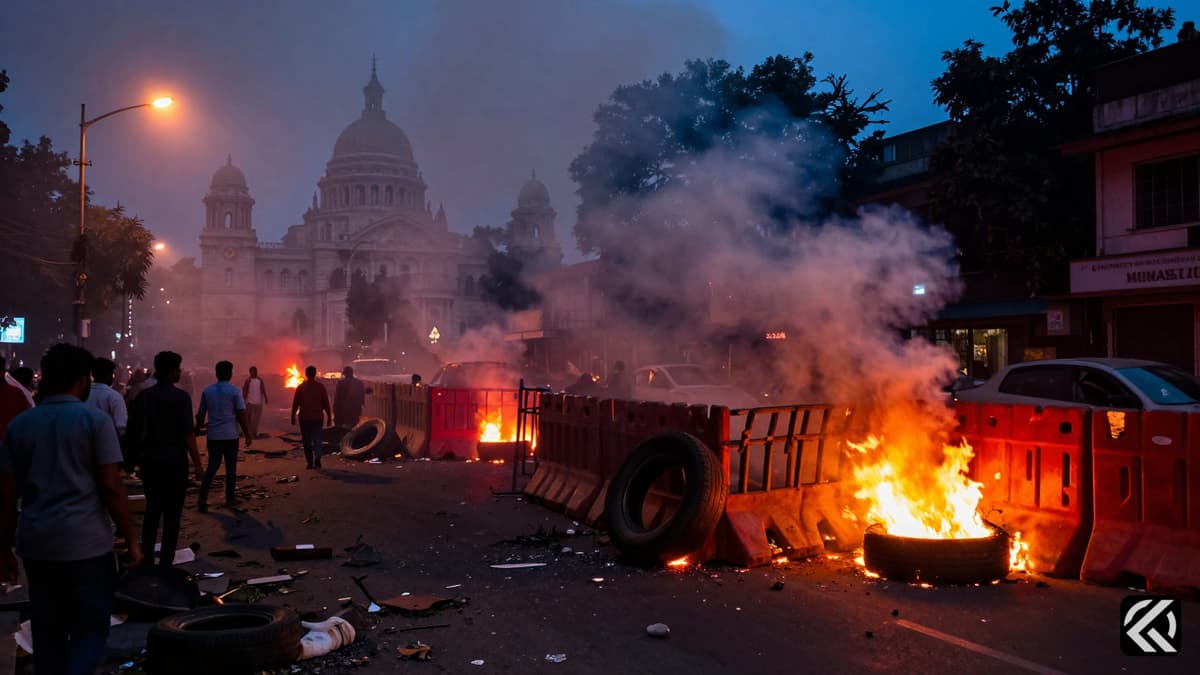
Violence erupts in West Bengal as an aide to a top BJP leader is shot dead following a historic electoral victory, raising fears of intensified post-poll unrest.
The aide to a prominent leader from the Bharatiya Janata Party (BJP) has been shot dead amid violent clashes in the eastern Indian state of West Bengal, escalating tensions following a historic electoral shift. The incident occurred on Wednesday night as Chandranath Rath, personal assistant to Suvendu Adhikari, was traveling home, marking the third death in the region since the election results were announced on Monday.
The killing of Rath has intensified fears of escalating violence in a state where clashes between rival party workers are unfortunately common. While police have arrested more than 400 individuals in connection with earlier incidents of intimidation, they have yet to make arrests regarding this specific murder. The incident underscores the volatile atmosphere surrounding the post-poll period, which has been characterized by allegations of voter disenfranchisement and physical confrontations.
Rath was targeted while on his way home on Wednesday night, a timing that suggests the violence is continuing to spread beyond immediate polling stations. Police officials have confirmed the discovery of a car linked to the crime, although its license plate number was reported to be incorrect. Additionally, investigators found live ammunition and fired cartridges at the scene, indicating a premeditated attack. A witness reported to media outlets that the shooter was positioned on a motorcycle, though police have not officially confirmed the number of attackers or the specific details of the getaway.
The murder of Rath has drawn immediate condemnation from across the political spectrum. Suvendu Adhikari, who is widely seen as the front-runner to become the next Chief Minister of West Bengal, described the death as "heartwrenching" and labeled it a "cold-blooded murder" in statements to reporters. His reaction highlights the personal toll of the political transition, as Adhikari himself recently defeated incumbent Chief Minister Mamata Banerjee in her stronghold of Bhabanipur, a significant personal and political milestone.
West Bengal Police Chief Siddh Nath Gupta provided updates on the investigation, emphasizing the forensic evidence collected. "We also found live rounds and fired cartridges from the spot," Gupta stated, underscoring the seriousness of the inquiry. The police are currently working to identify the perpetrators, but no arrests have been made in connection with this specific killing. This lack of immediate accountability fuels concerns among observers that the climate of impunity may be contributing to the ongoing unrest.
The Trinamool Congress (TMC), the party that had ruled West Bengal for 15 years, strongly condemned the killing in an official statement. "Violence and political killings have no place in a democracy and the guilty must be held accountable at the earliest," the party declared, demanding a court-monitored investigation. The TMC has also accused BJP workers of widespread vandalism, including the demolition of meat shops in Kolkata using bulldozers, a move they describe as part of a "pattern of intimidation." The BJP has denied these specific accusations, with state party chief Samik Bhattacharya asserting that the party does not support acts of violence.
The context of this violence is rooted in the broader narrative of the recent West Bengal election, which resulted in a landslide victory for the Bharatiya Janata Party. The party secured 207 seats out of 294, ending the long-standing rule of Mamata Banerjee's Trinamool Congress. Despite this decisive win, the post-poll period has been marred by allegations of voter roll manipulation, with Banerjee claiming that millions of non-BJP voters were unjustly removed from the lists. Both the BJP and the Election Commission have denied these allegations, yet the controversy has fueled a pervasive atmosphere of suspicion and tension.
Adhikari and other BJP leaders have pointed to the deterioration of law and order under the previous administration as a cause for the current instability. "As soon as our chief minister takes the oath and our government assumes power, everything will be set right though it may take a little time," said BJP minister Sukanta Majumdar. This assurance is set to be tested as the state prepares for a new administration. The new Chief Minister is expected to be sworn in on Saturday, with Adhikari emerging as the primary candidate to hold the office.
Visuals of arson and vandalism have emerged from multiple districts, including Murshidabad, Birbhum, Kolkata, and Howrah, complicating the celebration of victory for the BJP. Supporters have held rallies chanting slogans of 'Jai Shree Ram', but these events have been shadowed by reports of clashes and property damage. The TMC claims that their offices have been targeted, while the BJP alleges that their workers have also been victims, with each side blaming the other for the deaths. Police have not confirmed the party affiliations of all victims, leaving the narrative of victimhood contested.
A senior police officer told the BBC that directives from Chief Election Commissioner Gyanesh Kumar are in place to monitor law and order and take immediate action against violence. However, the officer noted that while deaths in this cycle are lower than in previous years, the atmosphere of intimidation remains pervasive. This suggests that the electoral process itself may have been compromised by fear, raising questions about the health of the democratic exercise in the state.
As the state moves toward the swearing-in ceremony, the focus will be on restoring order. The West Bengal election results mark a significant political realignment, but the immediate aftermath reveals deep fractures in civil society. The murder of Chandranath Rath serves as a stark reminder of the dangers associated with high-stakes political transitions in regions with entrenched rivalries.
The immediate future of West Bengal hinges on the ability of the incoming government to curb the cycle of violence and address the underlying grievances that fueled the election. The BJP's historic victory, driven by Adhikari's personal appeal and anti-incumbency against the TMC, has brought them to power but also placed them in a volatile environment. Predictive analysis suggests that if the new administration fails to deliver swift justice for Rath's murder and effectively manage the allegations of voter manipulation, the risk of sustained unrest and administrative paralysis increases. The coming weeks will test the BJP's capacity to govern a state that has seen intense polarization, requiring a delicate balance of law enforcement and political reconciliation to prevent the post-poll violence from destabilizing the newly established democratic mandate.
May 7, 2026 13:16 UTC
Rubio Meets Pope as Iran Weighs US War Proposal
Join 50,000+ readers getting the global briefing every morning.
No spam. Unsubscribe anytime.
May 7, 2026 11:58 UTC
Operation Sindoor: One Year Since Pahalgam Attack and Military Response
May 7, 2026 11:10 UTC
Iran War Forces Strait of Hormuz Control Amid Oil Price Volatility
May 7, 2026 07:45 UTC
Tamil Nadu Assembly Election: TVK Chief Minister Race Intensifies
May 7, 2026 07:16 UTC
Tehran Prepares Response as Ships Stranded in Strait of Hormuz Crisis


