Record-breaking voter engagement defines the 2026 Assam polls, though the day also saw clashes, arrests, and the tragic death of a polling official.
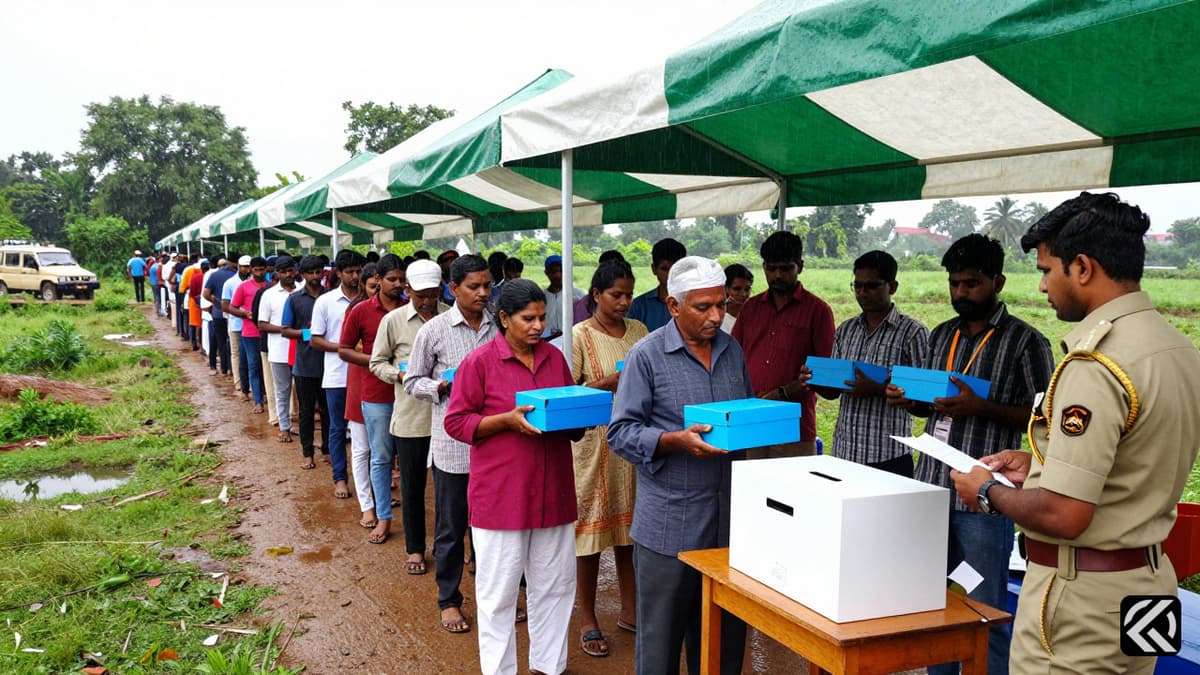
The Assam Assembly elections concluded on Thursday, April 9, 2026, following a day marked by record-breaking public participation and significant unrest. While officials announced a voter turnout of 85.64% as polling ended at 5 p.m., the democratic exercise was marred by reported violence, injuries, and the death of a poll official. Despite heavy showers and intermittent rain that lashed parts of the state, thousands of voters from first-time participants to octogenarians braved the weather to exercise their franchise. The day also saw high-profile political figures, including Chief Minister Himanta Biswa Sarma and AIUDF chief Badruddin Ajmal, casting their votes, while the Election Commission prepares for the counting scheduled for May 4.
Amidst the high voter turnout, the day was not without incident. Around 30 people were injured and seven individuals were arrested in connection with poll-related violence. Officials confirmed that clashes occurred between supporters of the Congress and BJP parties, with minor skirmishes erupting at several polling booths after voting began in the morning. Inspector General of Police (Law and Order) Akhilesh Kumar Singh noted that violence had taken place in Tamulpur and Sivasagar on Wednesday night, hours before the polls opened at 7 a.m. Additionally, a police complaint was lodged by the Karbi Anglong district administration regarding a video shared on social media that allegedly showed the voting process inside a polling station in the Diphu constituency, violating the strict ban on mobile phones. An FIR was registered under the Representation of the People Act, 1951, to investigate the incident.
The human cost of the election was highlighted by a tragic incident in the Sonitpur district, where a polling official, 45-year-old Deben Horo, was found dead. Deputed as the second polling officer for polling station No. 230 in Dolapani LP School, Horo was found unconscious in his bed. Despite being rushed to a nearby hospital, he was pronounced dead by doctors. While the cause of death remains unconfirmed, medical personnel suspect an underlying medical condition. This incident occurred as the Election Commission enforced strict security and voting protocols, including the mandatory deposit of mobile phones and bags before entering polling stations.
Political leaders from across the spectrum used the day to voice their demands and observations. Assam Pradesh Congress Committee president Gaurav Gogoi thanked the people for their massive turnout, attributing it to a desire for a "New Bor-Asom" and new leadership. He placed the onus on the Election Commission to ensure the security of EVMs and the accuracy of vote counting on May 4. Conversely, Raijor Dal president Akhil Gogoi characterized the election as a fight against a "fascist BJP government," urging voters to save democracy. Union Minister Sarbananda Sonowal, casting his vote in Dibrugarh, noted the public's happiness, though the full quote was truncated in reports.
The election dynamics were further shaped by the presence of international observers and the emotional involvement of local families. International delegates, part of the International Election Visitors' Programme, visited the Model Polling Station at Dimoria High School and other locations in the Kamrup (M) and Sualkuchi districts. They interacted with first-time and female voters, appreciating the festive environment and the smooth conduct of the polls. Meanwhile, late musician Zubeen Garg's wife, Garima Saikia Garg, and his sister cast their votes in Guwahati, urging for a government of their choice and the expeditious delivery of justice regarding the singer's death. Singer Papon also voiced concerns regarding high travel costs, suggesting that biometric or remote voting systems could assist families unable to vote due to ticket prices.
The voter turnout figures varied significantly across districts throughout the day. At 1 p.m., the turnout stood at 59.63%, with Dudhnoi in Goalpara recording the highest at 66.11% and Dibrugarh the lowest at 50.85%. By 3 p.m., Chamaria in Kamrup had the highest turnout at 84.43%, while New Guwahati saw the lowest at 60.57%. The final tally of 85.64% reflects a massive engagement despite the logistical challenges posed by the weather and the political tensions. Prominent candidates such as Debabrata Saikia, Pabitra Margherita, and Lurinjyoti Gogoi were among those who cast their votes early in the day, signaling the high stakes for the BJP-led NDA seeking a third term and the Congress aiming to reclaim power.
External support for the election process was also evident, with Arunachal Pradesh Chief Minister Pema Khandu urging Assam's citizens to participate actively. In his post on X, Khandu emphasized the power of each vote to shape the state's future, specifically calling on young voters and women to participate with confidence. This sentiment was echoed by the general atmosphere in districts like Jorhat, Kamrup, Kokrajhar, and Lakhimpur, where long queues formed despite the overcast skies. However, not all citizens were able to vote; families evicted from Kachutoli under the Dimoria Assembly constituency were denied entry by polling officials due to their names being removed from the voter list following their eviction, highlighting ongoing administrative and social friction.
The convergence of a record 85.64% voter turnout with reported violence and the death of a polling official suggests a complex electoral landscape for Assam. As the Election Commission prepares for the counting on May 4, the security of EVMs and the integrity of the process will face intense scrutiny. The high enthusiasm, particularly among first-time and female voters, indicates a robust democratic engagement that could define the political trajectory of the state for the next term. If the Election Commission can effectively address security concerns and administrative grievances, such as the voter list removals, the resulting government may inherit a mandate driven by a highly motivated electorate, even as the state grapples with the immediate aftermath of the election-related unrest.
Jun 8, 2026 00:51 UTC
Trump Claims Iran Nuclear Deal Imminent Despite Diplomatic Fractures
Jun 8, 2026 00:47 UTC
Iran Fires Missiles at Israel After Beirut Strike
Jun 7, 2026 22:00 UTC
US, Iran Peace Hops Fade 100 Days Into War
Jun 7, 2026 20:57 UTC
Iran Strikes Israel: IRGC Promises Week of Continuous Offensive
Jun 8, 2026 02:28 UTC
Trump Walks Out of Meet the Press After Rejecting Evidence Demands