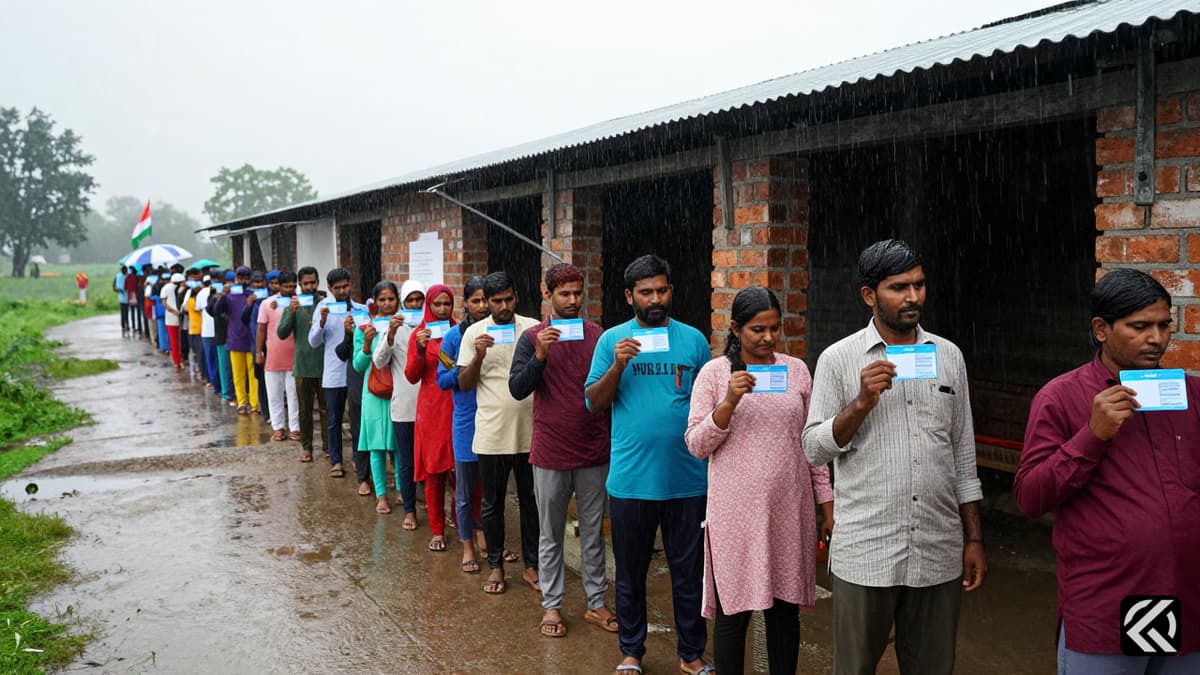
Amidst heavy rains and violence, Assam witnesses a historic 85.64% voter turnout as citizens demand change, justice for Zubeen Garg, and new leadership.
As the voting concluded in all 126 assembly constituencies of Assam, the state recorded a historic voter turnout record of 85.64% on Thursday, April 9, 2026. Despite heavy showers and intermittent rains that lashed parts of the state, citizens from first-time voters to octogenarians turned out in large numbers, defying the weather to exercise their franchise. The election, marking a critical moment for the BJP-led NDA seeking a third term and the Congress hoping to reclaim power, saw citizens voting with a desire for a "New Bor-Asom" and new leadership.
The day was marred by violence, with officials reporting that around 30 people were injured and seven were arrested in connection with poll-related clashes. Inspector General of Police Akhilesh Kumar Singh confirmed that violence erupted in Tamulpur and Sivasagar on Wednesday night, continuing as polling began at 7 a.m. on Thursday, with minor clashes reported at several polling booths. Amidst the tension, a poll official, Deben Horo (45), was found unconscious and later pronounced dead at a nearby hospital in the Naduar constituency of Sonitpur district, though the cause remains unconfirmed.
Political leaders used the platform of the polls to voice strong grievances and demands. Assam Pradesh Congress Committee president Gaurav Gogoi thanked the electorate for their massive participation, emphasizing that the people voted for a change. Meanwhile, AIUDF chief Badruddin Ajmal, after casting his vote in Hojai, expressed strong enthusiasm for the party's "lock and key" symbol. Speaking to ANI, Ajmal explicitly urged the public to vote for "justice for Zubeen Garg," alongside demands for education and technology. This call resonated deeply, as Zubeen Garg's wife, Garima Saikia Garg, and sister also cast their votes in Guwahati, expressing hope for expeditious justice for the late musician.
Singer and voter Papon, after voting in Guwahati, highlighted the socioeconomic barriers preventing some from voting. He noted that high travel ticket prices were causing many to miss out on the democratic process. Papon suggested that biometric or fingerprint scanning, or a remote voting system, would be beneficial to ensure broader participation. His comments underscored a growing sentiment among voters regarding accessibility, even as the Election Commission maintained that 38.92% had voted in the first four hours, eventually climbing to the final 85.64%.
The integrity of the voting process faced challenges as well. The Karbi Anglong district administration lodged a police complaint after a video purportedly showing the voting process was shared on social media. Filmed inside a polling station in the Diphu constituency, the video violated the Election Commission's ban on mobiles, leading to the registration of an FIR under the Representation of the People Act, 1951. Mobiles are strictly prohibited inside polling stations, with provisions for depositing such items before entry. The election commission reiterated its responsibility to ensure the security of EVMs and accurate vote counting on May 4.
While the election commission managed the logistics, international observers joined the festive atmosphere. International delegates, part of the International Election Visitors' Programme, visited the Model Polling Station at Dimoria High School in Kamrup (M) and polling stations in the Hajo Sualkuchi constituency. They interacted with first-time and female voters, praising the smooth and festive conduct of the polls. Similarly, Assam Chief Minister Himanta Biswa Sarma cast his vote in Guwahati, accompanied by his family, after offering prayers at the Kamakhya Temple, signaling his bid for a third consecutive term from the Jalukbari seat.
However, the political rhetoric remained sharp. Raijor Dal president Akhil Gogoi, contesting from Sivasagar, accused the government of being "fascist" and "undemocratic," claiming the electorate was voting to save democracy. He stated that people were turning up in large numbers to change the government, a sentiment echoed by Arunachal Pradesh CM Pema Khandu, who urged Assam's youth and women to participate with enthusiasm. Families evicted from Kachutoli in the Dimoria constituency faced entry denial due to name removals, highlighting the complexities of voter eligibility lists on election day.
The 2026 Assam Assembly Elections concluded with a resounding display of democratic will, yet the shadow of unresolved political tensions and specific justice demands remains. The high turnout of 85.64% suggests a populace deeply invested in the outcome, driven by a mix of desire for administrative change and specific calls for legal redress regarding Zubeen Garg. As the Election Commission prepares for the counting of votes on May 4, the aftermath will likely be defined by the political fallout of the reported violence and the judicial processes regarding the poll official's death. The widespread call for "justice for Zubeen Garg" may continue to influence campaign narratives in the aftermath, potentially reshaping the political discourse in the state as the new leadership is determined. The ability of the administration to address the logistical grievances raised by voters like Papon could also set a precedent for future electoral accessibility in the region.
Jun 8, 2026 00:51 UTC
Trump Claims Iran Nuclear Deal Imminent Despite Diplomatic Fractures
Jun 8, 2026 00:47 UTC
Iran Fires Missiles at Israel After Beirut Strike
Jun 7, 2026 22:00 UTC
US, Iran Peace Hops Fade 100 Days Into War
Jun 7, 2026 20:57 UTC
Iran Strikes Israel: IRGC Promises Week of Continuous Offensive
Jun 8, 2026 02:28 UTC
Trump Walks Out of Meet the Press After Rejecting Evidence Demands