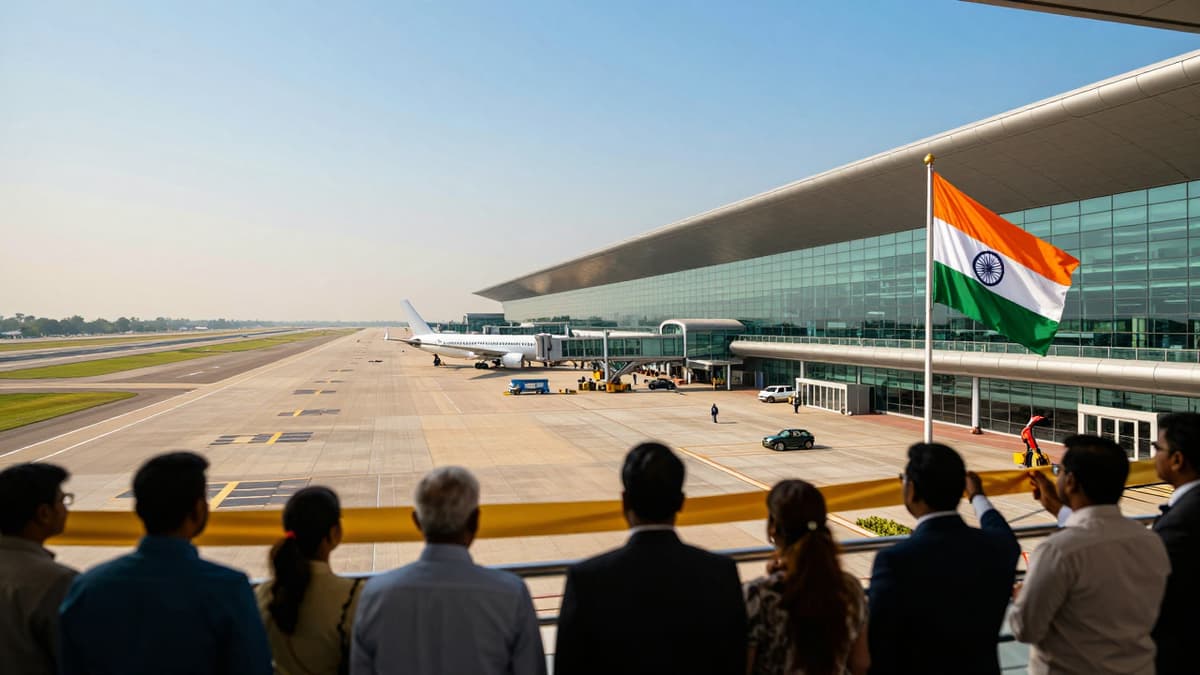
Prime Minister Narendra Modi formally launched the region's second airport, marking a transformative phase for India's aviation sector and western Uttar Pradesh economy.
Prime Minister Narendra Modi officially inaugurated the Noida International Airport on Saturday, March 28, 2026, marking the formal start of the National Capital Region's second airport. This inauguration represents a significant milestone for the State of Uttar Pradesh and the country as a whole, signaling the launch of a new era for development. The project, backed by an investment of ₹11,200 crore, was originally planned with an initial phase designed to handle 12 million passengers annually.
The timeline of the project reveals a complex history, as the inauguration comes just four years after the foundation stone was laid in November 2021. Although flights were previously scheduled to commence in October 2025, operations at the airport remain unannounced as of Saturday's event. The concession agreement for this massive infrastructure undertaking was signed in 2020 with the Swiss firm Zurich Airport International AG, underscoring the international scale and expertise involved in the development.
During his address, the Prime Minister stated that the launch signals a transformative phase for both the state and the nation. "Today we are starting a new chapter for a developed Uttar Pradesh and a developed India," PM Modi declared, highlighting the strategic importance of the facility. He noted that the airport is designed to serve a vast catchment area, including Agra, Mathura, Aligarh, Ghaziabad, Meerut, Etawah, Bulandshahr, and Faridabad, significantly expanding regional connectivity.
While celebrating the inauguration, the Prime Minister also addressed the critical global context, pointing to the ongoing conflict in West Asia as a cause for concern. He noted that the conflict, which has persisted for over a month, has disrupted the supply of essential commodities such as food, petrol, diesel, gas, and fertilizers in several countries. Since India imports a significant share of its crude oil and gas from the region, the government is actively working to cushion the impact on citizens. PM Modi assured the public that every possible step is being taken to ensure the burden of this crisis does not fall on ordinary families and farmers.
He appealed to the people to face this global West Asia crisis with calm and patience, describing it as a strength inherent in the Indian population. Amidst these challenges, the Prime Minister stressed that the growth in the aviation sector creates tremendous opportunities for the youth, including pilots, cabin crew, and maintenance professionals. Noting that 85% of Indian aircraft currently travel abroad for Maintenance, Repair, and Overhaul (MRO) services, the PM announced that a foundation for a similar facility has also been laid at the Noida airport.
The project envisions a long-term plan to expand capacity to 70 million passengers per year with up to six runways, moving far beyond the initial single-runway design. Chief Minister Yogi Adityanath emphasized that the airport will facilitate a dedicated multimodal cargo hub, helping the state overcome the limitations of being landlocked and connect more easily with global markets. The Prime Minister congratulated the people of the state, particularly those in western UP, stating that the airport will stand as a symbol of a developed Uttar Pradesh taking flight, directly connecting the region to the world.
The inauguration of the Noida International Airport coincides with a period of significant global economic uncertainty, yet it positions the National Capital Region for substantial long-term growth. The strategic decision to lay the foundation for a local MRO facility directly addresses the critical gap where 85% of current Indian aircraft maintenance occurs abroad, promising to retain revenue within the country. As the airport prepares to expand from its initial 12 million passenger capacity to a projected 70 million annually with multiple runways, it will likely transform the economic landscape of western Uttar Pradesh. The development is expected to catalyze a surge in small and medium enterprises and create a robust employment ecosystem for the local youth, ensuring that the region becomes a central hub for both passenger travel and freight logistics. Despite the disruptions caused by the conflict in the Middle East affecting global supply chains, the completion of this infrastructure marks a decisive step toward economic resilience and self-reliance for the nation.
Jun 8, 2026 00:51 UTC
Trump Claims Iran Nuclear Deal Imminent Despite Diplomatic Fractures
Jun 8, 2026 00:47 UTC
Iran Fires Missiles at Israel After Beirut Strike
Jun 7, 2026 22:00 UTC
US, Iran Peace Hops Fade 100 Days Into War
Jun 7, 2026 20:57 UTC
Iran Strikes Israel: IRGC Promises Week of Continuous Offensive
Jun 8, 2026 02:28 UTC
Trump Walks Out of Meet the Press After Rejecting Evidence Demands


