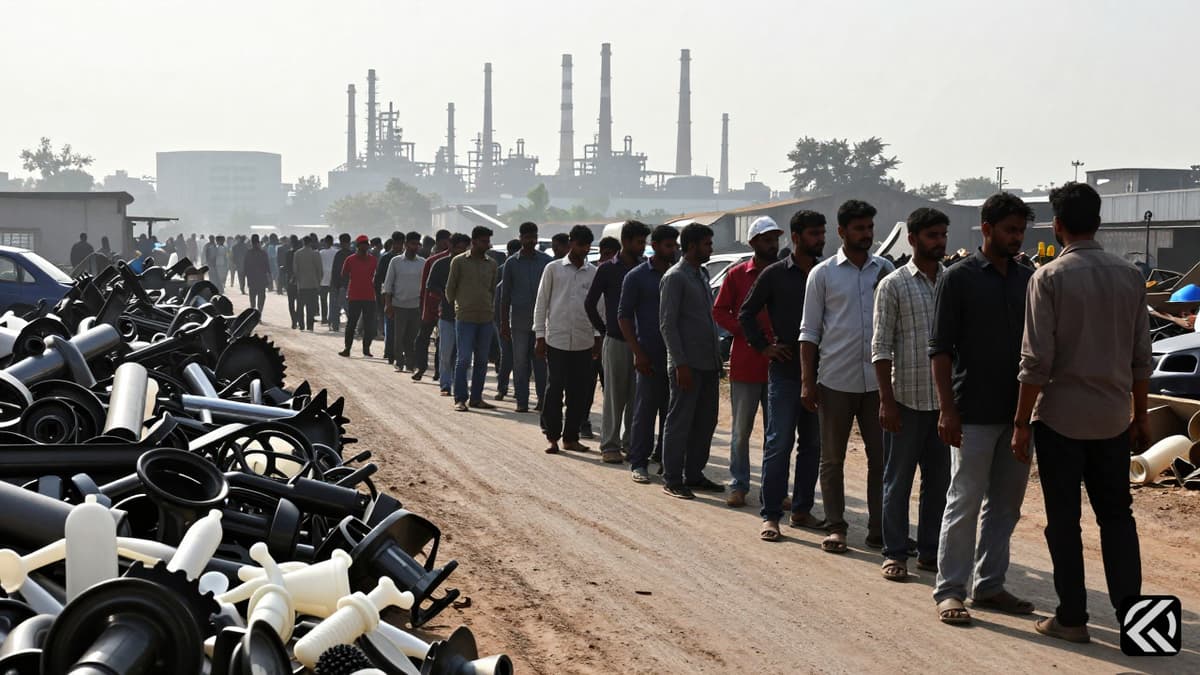
Escalating unrest in Noida sees thousands of non-unionised workers demanding wage adjustments as living costs soar, sparking police intervention.
What began as small, peaceful demonstrations in northern India has escalated into significant unrest, with police deploying tear gas and arresting more than 300 individuals in Noida. The unrest is driven by migrant labour workers and non-unionised contract employees in small factories who demand a hike in minimum wages that have remained largely unchanged for years.
As the situation intensifies, the Uttar Pradesh government has announced a temporary wage increase in two districts, promising further measures to address the grievances. The primary drivers of this unrest are the stark reality that most workers earn between 10,000 and 15,000 rupees monthly, a sum that barely covers basic expenses like 5,000 rupees in rent and 4,000 rupees on groceries.
Factory worker Soni Singh, a primary voice in the movement, highlights the disparity between effort and pay. He notes that while he works 12 to 14 hours daily, he is only compensated for overtime on three hours beyond the standard eight-hour shift. His monthly income sits at approximately 13,000 rupees, a figure that reflects a broader trend where wages have failed to keep pace with the escalating cost of living crisis.
The nature of these India worker protests is distinct from previous labour movements due to a notable absence of major trade union leadership. A union leader, who spoke on condition of anonymity for fear of police action, explained that the lack of organized leadership is unusual and suggests a grassroots, desperate mobilization by workers who feel they have little choice but to accept low pay because jobs are scarce.
Government data underscores the severity of the economic pressure: approximately nine in ten Indian workers earn less than 25,000 rupees a month. This earnings bracket is comparable to minimum wages for skilled workers in Delhi, the highest in the country, yet it leaves the vast informal sector, which employs over 310 million people, with little job security and minimal financial resilience.
For many households, the financial gap is widening rapidly. Recent increases in cooking gas prices, linked to global supply disruptions caused by the conflict in the Middle East, have exacerbated the strain on already stretched budgets. Rakhi Sehgal, an independent labour researcher and former consultant with the International Labour Organisation, identified the "cost of living crisis" as the common thread uniting these recent protests. She noted that the movements reflect the widening gap between stagnant wages and the soaring cost of basic necessities.
The response from the business sector highlights the complexity of the situation. Vaibhav Gupta, who runs a plastic utensils factory in Delhi employing about 50 workers, expressed understanding for the pressure on workers but cautioned that sudden labor cost increases are difficult for small businesses to manage. He stated that while the industry must listen when labour comes together to demand a raise, doing so often means cutting into already thin margins or absorbing losses on existing purchase orders.
Nikhil Dey, a labour rights activist, pointed out that in situations where small factories cannot make other cost adjustments, they tend to squeeze workers' time and wages, leading to exploitation. This dynamic creates a cycle where workers are forced to work longer hours for overtime pay that covers only a fraction of their actual labor, reinforcing the frustration fueling the current demonstrations.
The protests also coincide with growing frustration over India's new labour codes. Introduced last year, these reforms aimed to bring dozens of existing labour and industrial laws into four broader frameworks to strengthen protections and simplify compliance. However, the practical application of these codes continues to face challenges. Arvind Goel, co-chair of the industrial relations committee at the Confederation of Indian Industry, suggested that the government should consider bearing some social security costs for micro and small enterprises. This measure could help businesses comply with labour laws and potentially reduce disputes with their workforce.
Despite the government's temporary wage increases and promises of further measures, the sentiment among the workers remains one of uncertainty and exhaustion. One factory worker remarked, "We're working more every year, but not getting ahead." This sentiment is echoed by another who questioned the future viability of their livelihoods, asking, "If this is the future, how will we ever live a decent life - or save anything for our children?"
The government of Uttar Pradesh has announced a temporary wage increase in two districts as a direct response to the escalating India worker protests. While this move offers immediate relief to the most affected areas, the underlying issues regarding the vast informal sector and the lack of wage revisions for years persist. If the current trend of rising living costs, including gas prices driven by global conflicts, continues without a substantial overhaul of wage structures for the informal sector, the cycle of exploitation described by activists like Nikhil Dey may intensify. Small businesses, struggling with thin margins, may continue to rely on squeezing worker hours rather than raising wages, potentially leading to further fragmentation in labour relations and prolonged unrest across the industrial clusters of northern India.
Jun 8, 2026 00:51 UTC
Trump Claims Iran Nuclear Deal Imminent Despite Diplomatic Fractures
Jun 8, 2026 00:47 UTC
Iran Fires Missiles at Israel After Beirut Strike
Jun 7, 2026 22:00 UTC
US, Iran Peace Hops Fade 100 Days Into War
Jun 7, 2026 20:57 UTC
Iran Strikes Israel: IRGC Promises Week of Continuous Offensive
Jun 8, 2026 02:28 UTC
Trump Walks Out of Meet the Press After Rejecting Evidence Demands


