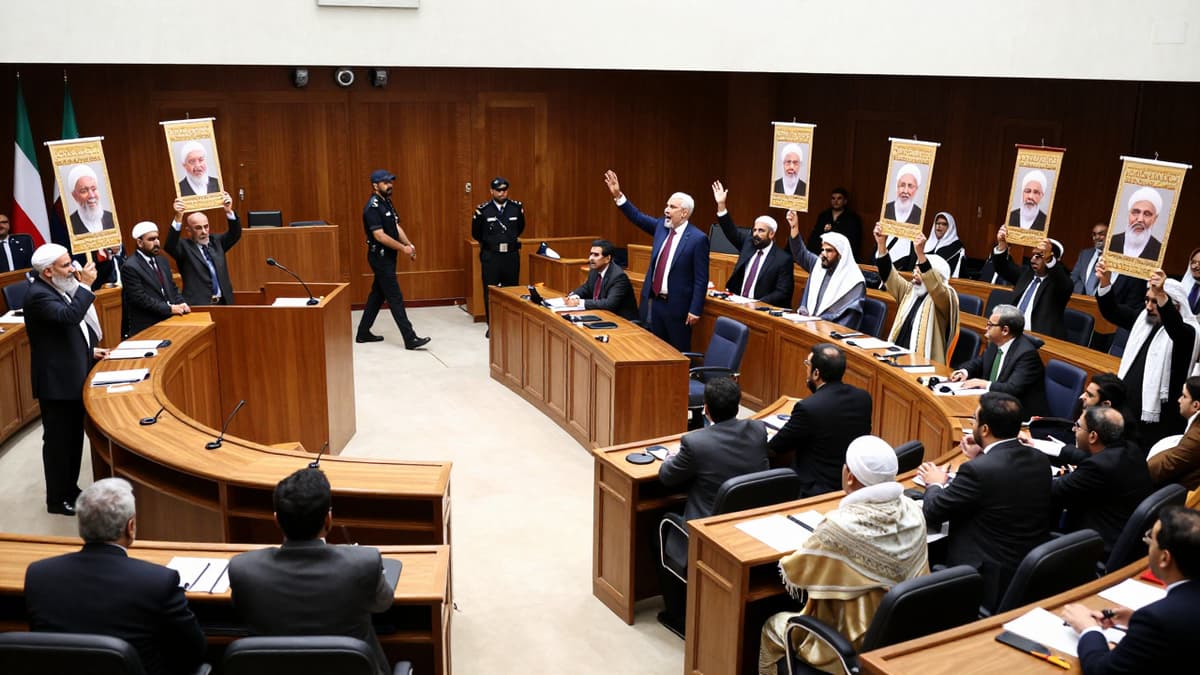
A fierce confrontation unfolded in the legislative chamber as National Conference members marched against international aggression, leading to police intervention and a heated row.
The Jammu and Kashmir Assembly descended into chaos on Friday as a major confrontation broke out between National Conference (NC) members and other legislative bodies. This volatile situation occurred as NC MLAs staged a significant protest against the reported killing of former Iranian Supreme Leader Ayatollah Khamenei. The protest was also a direct response to ongoing military actions involving the US and Israel in Iran. Video footage captured during the event shows members chanting slogans and holding portraits of the late leader inside the house, escalating the atmosphere into a full-blown ruckus.
The initial phase of the disturbance was triggered by the NC's vocal opposition to what they termed as an unjust attack. As the protest gained momentum, tensions reached a breaking point, leading to a direct clash between opposing parties. Police forces were eventually deployed to the scene to restore order as the situation threatened to spiral out of control. The confrontation intensified specifically when BJP MLAs countered the NC's demonstration, culminating in a physical scuffle between Congress MLA Irfan Hafiz Lone and BJP MLA Yudvir Sethi.
The severity of the incident forced the immediate adjournment of the assembly proceedings to allow the situation to calm down. The protest was spearheaded by National Conference leaders who emphasized their unwavering solidarity with the people of Iran. Tanvir Sadiq, a party MLA, articulated the group's stance, stating, "We are standing in solidarity with Iran. The entire National Conference and the government of J&K are standing with them." Sadiq further argued that no country possesses the right to attack another, demanding that India's top leadership explicitly condemn the actions taken against Iran. He emphasized that the party supports the Iranian people specifically in the wake of the killing of Ayatollah Khamenei.
Chief Minister Omar Abdullah also addressed the conflict, condemning the ongoing hostilities in West Asia. In a statement issued during the proceedings, Abdullah asserted that regime change cannot be achieved through military bombardment. He highlighted the fundamental principle that "the only people who get to choose their regime are the citizens of that country." Abdullah characterized the killing of Khamenei as a "gross misuse of force and violation of international law," reinforcing the legislative body's condemnation of the military strategy employed in the region.
The escalation within the assembly is rooted in the broader geopolitical tensions that have gripped the region. Tensions in the area spiked following joint US-Israel military strikes on Iran on February 28. These strikes resulted in the death of Ayatollah Khamenei and several senior leaders of the Islamic Republic. In response to these lethal actions, Iran launched its own retaliatory strikes against US bases in Gulf countries and Israel. This cycle of aggression has fueled the sentiment within the J&K Assembly, prompting the Iran protest to become a focal point of the day's legislative business. The NC's actions reflect a broader political stance against the perceived violation of sovereignty and international norms by external powers.
The Jammu and Kashmir Assembly has now become a stage for international diplomatic grievances to be played out domestically, highlighting the deep emotional and political investment local leaders feel regarding the situation in West Asia.
The chaotic events in the Jammu and Kashmir Assembly indicate a significant shift where regional legislative bodies are becoming more vocal about global conflicts. The physical confrontation and the strong condemnation from Chief Minister Omar Abdullah suggest that political rhetoric in the region will continue to align closely with the principles of non-interference and the condemnation of aerial bombardment. Given the intensity of the protest led by the NC and the subsequent police intervention, it is likely that future assembly sessions will see heightened scrutiny of international military actions. If similar geopolitical tensions persist or escalate, the region's legislative bodies may continue to adopt assertive stances, potentially influencing broader national discourse on foreign policy neutrality. The demand for India's top leadership to condemn such actions implies a growing expectation for a clear political signal from the center regarding the conflict.
Jun 8, 2026 00:51 UTC
Trump Claims Iran Nuclear Deal Imminent Despite Diplomatic Fractures
Jun 8, 2026 00:47 UTC
Iran Fires Missiles at Israel After Beirut Strike
Jun 7, 2026 22:00 UTC
US, Iran Peace Hops Fade 100 Days Into War
Jun 7, 2026 20:57 UTC
Iran Strikes Israel: IRGC Promises Week of Continuous Offensive
Jun 8, 2026 02:28 UTC
Trump Walks Out of Meet the Press After Rejecting Evidence Demands


