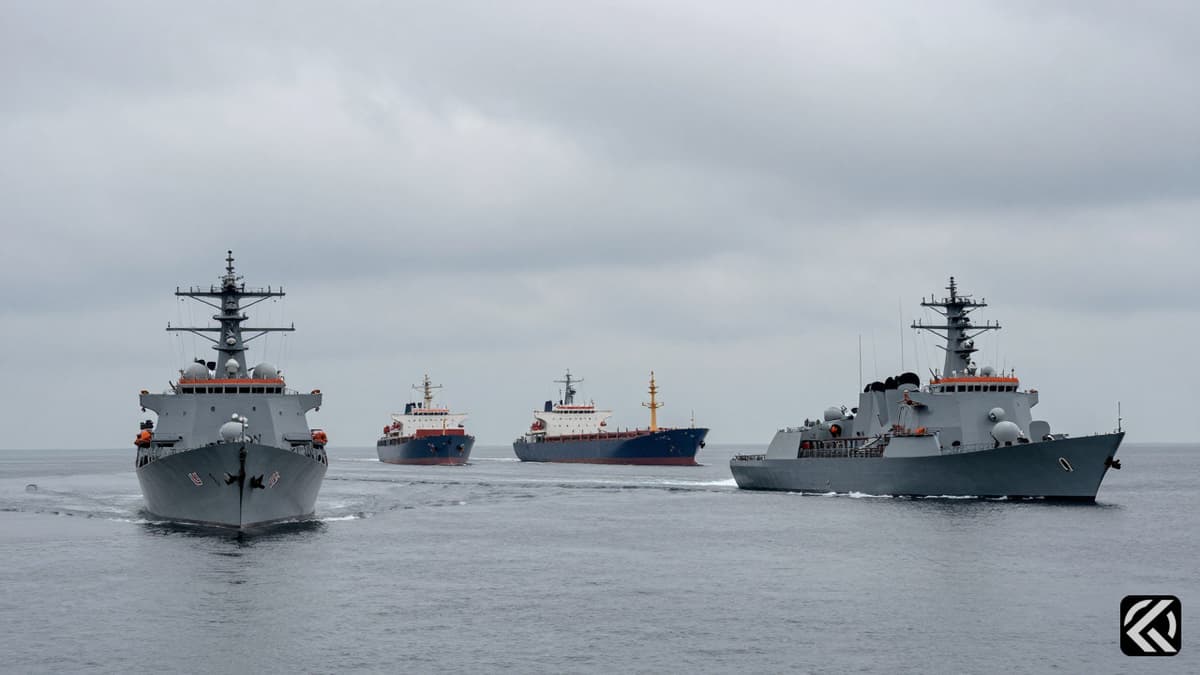
Tensions escalate as the US initiates ship guidance in the Strait of Hormuz, prompting Iranian threats of attack. The ceasefire hangs in the balance amid stalled nuclear program negotiations.
The US and Iran are approaching the one-month mark of their ceasefire agreement, but tensions remain critically high as President Donald Trump announced that US forces would begin guiding merchant ships through the key maritime chokepoint. This move signals a major escalation in the geopolitical standoff, threatening the fragile peace that has held for weeks.
On Sunday, President Trump declared that the US would support merchant vessels seeking to transit the essential international trade corridor, responding to requests from countries uninvolved in the Middle Eastern dispute. US Central Command confirmed the operation would involve guided-missile destroyers, over 100 aircraft, and 15,000 service members. However, senior Iranian official Ebrahim Azizi issued a stark warning, stating that any US interference in the strait would be considered a violation of the ceasefire.
The situation has deteriorated rapidly since the initial ceasefire was announced on April 7, following Trump’s warning that “a whole civilization will die” if Iran did not reopen the strait. Since then, diplomatic efforts have oscillated between breakthroughs and deadlocks. Initial face-to-face talks in Islamabad on April 11 lasted 21 hours but failed to produce an agreement, largely due to Iran’s refusal to abandon its nuclear program. Vice President JD Vance confirmed the failure, noting that the US negotiators felt trust was not established by their counterparts.
Despite the diplomatic freeze, Trump stated the ceasefire was “holding well” in early April. However, the US soon implemented a blockade of Iranian ports, which Trump insisted would continue until a final deal was reached. Iran retaliated by announcing it would reopen the strait in response to a separate Israel-Lebanon ceasefire, only for Trump to threaten further escalation if a deal was not reached by the end of the ceasefire period.
By mid-April, Iran once again shut down the Strait of Hormuz, blaming the US for “breaches of trust.” Trump expressed frustration, saying Iran “got a little cute,” while Iranian negotiator Mohammad Bagher Ghalibaf stated the two sides were still far from a final agreement. The diplomatic dance continued into late April and early May, with both sides sending delegations to Pakistan for talks, only for Trump to cancel the US delegation on April 25 due to alleged “infighting” among Iran’s leadership.
As of late April, Iranian Foreign Minister Abbas Araghchi delivered a list of “red lines” to Pakistani mediators. Reports indicate Iran submitted a proposal to reopen the strait, but Trump signaled he was unlikely to accept it without guarantees on the nuclear program. On April 29, Trump explicitly rejected Iran’s proposal, stating he first wanted assurances on curbing Tehran’s nuclear activities.
In recent days, the situation has grown more volatile. On May 2, a senior Iranian military official warned that renewed conflict was “possible” after the rejection of the proposal. Iran’s semi-official Tasnim news agency reported that Tehran had submitted a 14-point response to a US proposal. On May 3, Iranian foreign ministry spokesperson Esmaeil Baghaei confirmed that the US had responded to Iran’s proposal and that Tehran was reviewing Washington’s reply. Simultaneously, US special envoy Steve Witkoff told CNN that the US was “in conversation” with Iran.
Trump, however, remained blunt about his options. On May 1, he said his choices were to make a deal or “go and just blast the hell out of them.” He later described negotiations as happening “telephonically” and noted he was “not satisfied” with the latest proposal sent to Pakistani mediators. Despite the threats, Trump claimed his representatives were having “very positive discussions” with Iran as the two countries traded peace proposals.
The humanitarian and economic toll of the conflict continues to mount. More than 12,000 residential buildings in Iran damaged during the war have been repaired, according to the head of Iran’s Basij Construction Organization. Meanwhile, the average price of a gallon of US regular gas is up nearly 50% since the war began on February 28. In Lebanon, over 2,600 people have been killed in Israeli strikes since March 2, despite a ceasefire.
The immediate future of the Strait of Hormuz depends on whether Trump extends the ceasefire or opts to continue bombing Iran. The US will begin guiding ships today, a move that Iran has explicitly warned will trigger attacks on American forces. If Tehran follows through on these threats, the Iran US ceasefire will effectively collapse, leading to broader regional conflict. The lack of progress on the nuclear program remains the primary obstacle to a permanent resolution. With Trump stating he cannot imagine the current proposal being acceptable, and Iran maintaining its red lines, the likelihood of renewed military engagement is high. The international community’s reliance on the strait for trade exacerbates the stakes, making any disruption a global economic concern. The coming days will determine whether diplomacy can reverse the trajectory toward war or if the region faces a full-scale confrontation.
May 4, 2026 15:20 UTC
US Launches Project Freedom to Guide Ships Through Strait of Hormuz
May 4, 2026 11:22 UTC
Iran Threatens Attack as US Guides Ships in Hormuz
May 4, 2026 01:55 UTC
Nepal Blocks Kailash Mansarovar Yatra via Lipulekh Pass
May 3, 2026 23:02 UTC
Trump Reviews Iran's Latest Ceasefire Offer Amid Blockade
May 4, 2026 19:32 UTC
West Bengal Elections 2026: Counting Begins Amidst SIR Impact


