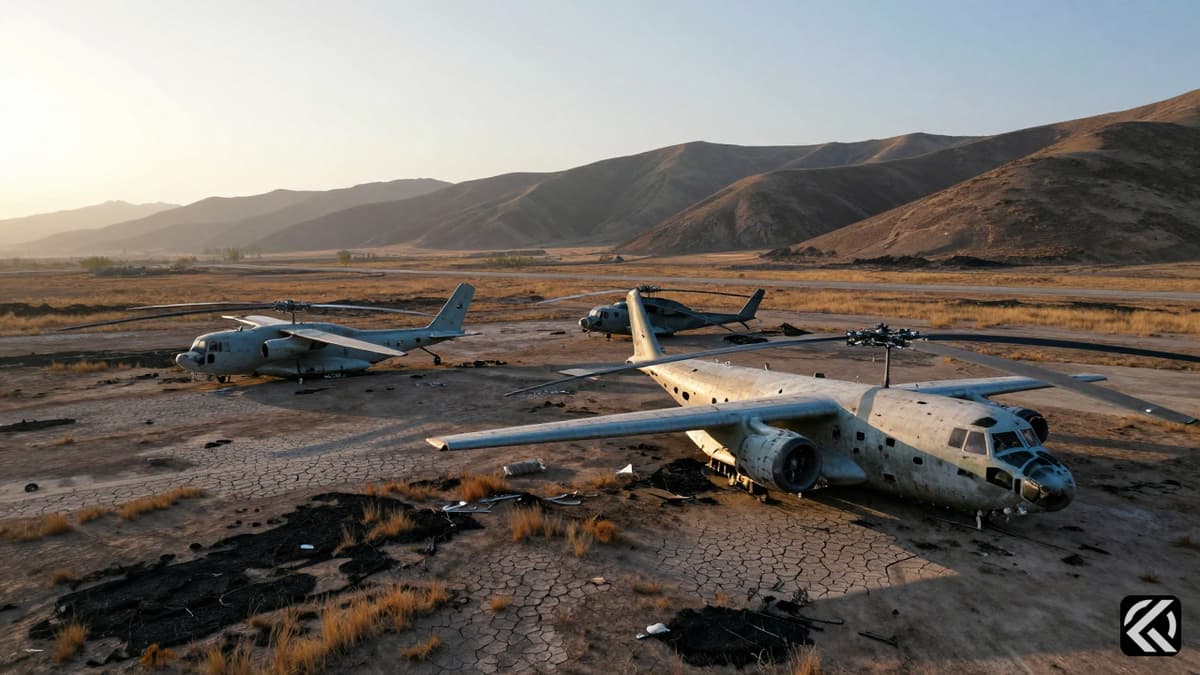
Tensions flare as Iran's military denies a U.S. rescue success, claiming a daring mission in Isfahan ended in total failure with multiple aircraft destroyed by Iranian forces.
The military of Iran asserted on Sunday, April 5, 2026, that a recent American attempt to recover a missing airman was completely thwarted. The operation utilized an abandoned airfield in southern Isfahan province, serving as the focal point for a Isfahan rescue operation that Tehran insists was a total failure. According to military officials, the United States claimed the pilot was saved, but the opposing narrative paints a starkly different picture of the events that unfolded in the region.
Ebrahim Zolfaghari, the spokesman for the military's central command, Khatam Al-Anbiya, issued a forceful statement refuting the American account. He labeled the event a "so-called U.S. military rescue operation," asserting that it was a "deception and escape mission" planned under the guise of recovering the pilot of a downed aircraft. Zolfaghari confirmed that the Iranian forces successfully "foiled" the entire effort, ensuring that the U.S. objective was not met. This declaration directly contradicts the timeline and outcomes presented by American officials, setting the stage for a significant diplomatic and military confrontation.
The dispute centers on the fate of an F-15E Strike Eagle fighter jet, which a U.S. Air Force officer was flying when it was shot down in Iran on Friday, April 3, 2026. Following the incident, President Donald Trump announced on Sunday, April 5, that Special Operations forces had successfully rescued the officer during the previous night's mission. The President characterized the event as "one of the most daring search and rescue operations in U.S. history," implying a significant tactical victory for American forces. However, the Iranian military's account dismantles this narrative, claiming instead that the operation was not just failed, but resulted in the destruction of multiple assets.
According to Zolfaghari's detailed breakdown, the Iranian military destroyed two C-130 military transport planes and two Black Hawk helicopters during the engagement. The spokesman further noted that two drones were also eliminated during the confrontation. These claims suggest a sophisticated and coordinated defense against the U.S. incursion. The sheer number of vehicles lost-four aircraft and two drones-indicates a high-intensity engagement that would classify the event as a major Iran-U.S. military clash in the modern era. The location, an abandoned airport in the southern part of Isfahan province, provided the setting for this intense exchange, turning a remote desert strip into a theater of conflict.
The timeline of the dispute reveals a rapid escalation of narratives. The F-15E was downed on Friday, prompting a weekend response. By Saturday night, American forces reportedly executed their rescue. Within hours, President Trump publicly validated the success of the mission. Yet, by Sunday morning, the Iranian military had already countered with a detailed report of destruction. The discrepancy between the U.S. claim of a successful extraction and the Iranian claim of a total decimation of their force underscores the complexity of the Isfahan rescue operation. It presents a scenario where two nations offer mutually exclusive accounts of the same physical events.
The divergence in reporting highlights the critical role of information warfare in modern Iran-U.S. military clash scenarios. While the United States focuses on the successful retrieval of its servicemember, Iran focuses on the material damage inflicted on the American fleet. The destruction of C-130s and Black Hawks, which are heavy-lift transport and utility assets respectively, suggests that the U.S. operation relied heavily on these platforms for insertion and extraction. The loss of these assets, according to Iranian spokespeople, represents a significant tactical setback for the United States, potentially impacting future operational capabilities in the region.
Furthermore, the involvement of drones indicates a layered approach to the conflict, where unmanned systems were likely used for surveillance or support during the rescue attempt. The Iranian military's ability to identify and neutralize these drones, along with the manned aircraft, suggests a robust air defense network in the Isfahan area. The fact that the operation was termed a "deception and escape mission" by Iranian officials points to a belief that the U.S. objective extended beyond mere rescue, possibly involving intelligence gathering or a show of force that was not fully understood by the American leadership until the operation failed.
The aftermath of this Isfahan rescue operation will likely dictate the immediate diplomatic and strategic posture of both nations. For the United States, the public assertion by President Donald Trump of a successful mission may serve to bolster domestic morale and project strength, regardless of the Iranian counter-claims. However, the detailed nature of the Iranian report, specifying the types and number of destroyed aircraft, demands a rigorous verification process by Washington. If the Iranian claims hold true, the incident could necessitate a reevaluation of U.S. rescue protocols and the perceived risks of operating in contested airspace near Iranian borders.
The conflicting accounts of the Isfahan rescue operation signal a deepening rift, as Iran's specific claims of destroying two C-130s and two Black Hawks challenge the narrative of a flawless U.S. victory. As the world watches, the immediate impact will be heightened military alertness in the region, with both sides scrutinizing the validity of the other's reports. If the Iranian assessment of the Iran-U.S. military clash is accurate, the strategic balance in the Middle East could shift, forcing the U.S. to reassess its operational readiness. Conversely, the American insistence on the success of the rescue, championed by President Donald Trump, suggests a resolve to maintain dominance despite the reported losses. The coming days will likely see intense diplomatic maneuvering as both nations attempt to solidify their narratives and determine the long-term consequences of this intense aerial engagement.
Jun 8, 2026 00:51 UTC
Trump Claims Iran Nuclear Deal Imminent Despite Diplomatic Fractures
Jun 8, 2026 00:47 UTC
Iran Fires Missiles at Israel After Beirut Strike
Jun 7, 2026 22:00 UTC
US, Iran Peace Hops Fade 100 Days Into War
Jun 7, 2026 20:57 UTC
Iran Strikes Israel: IRGC Promises Week of Continuous Offensive
Jun 8, 2026 02:28 UTC
Trump Walks Out of Meet the Press After Rejecting Evidence Demands


