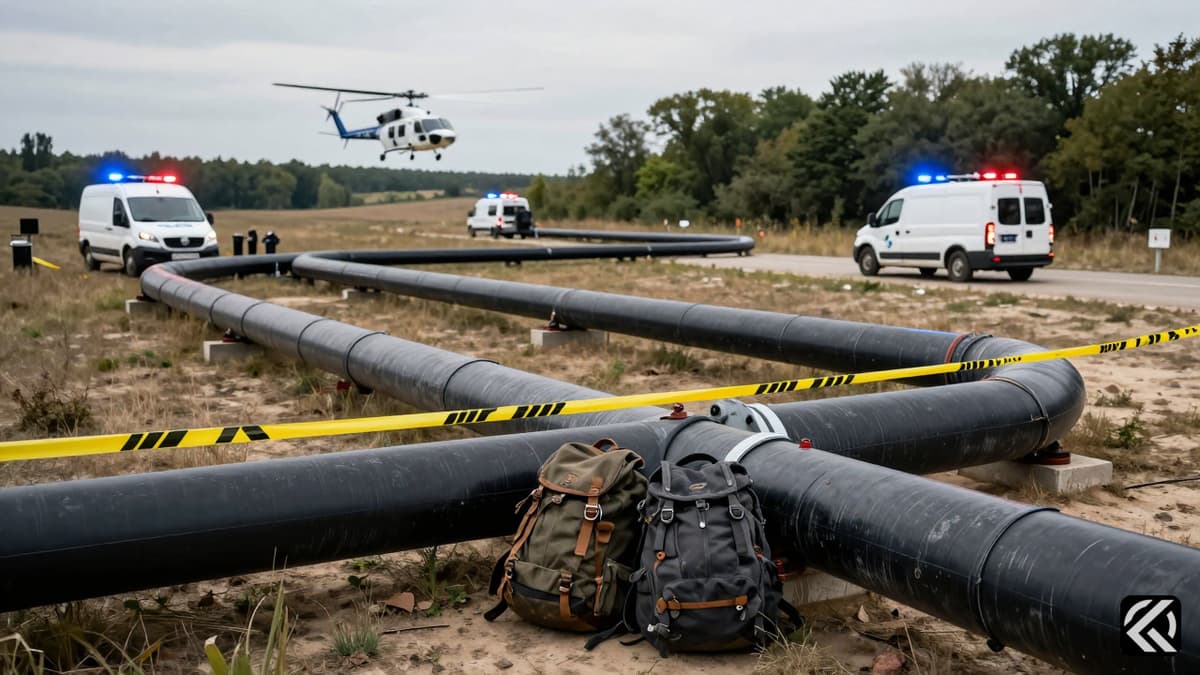
Explosives found near a critical gas line connecting Serbia and Hungary spark emergency responses, highlighting energy ties to Russia and rising regional tensions just before Hungary's vote.
Serbia President Aleksandar Vucic announced on Sunday that two backpacks containing explosives were discovered near a critical gas pipeline carrying Russian energy close to the Hungarian border. The incident, located in the northern town of Kanjiza, raises immediate security concerns for the region's vital infrastructure.
Vucic stated the backpacks held "two large packages of explosives with detonators," situated just a few hundred meters from the active gas line. The discovery has triggered an extensive police presence in the area, with roadblocks established and helicopters monitoring the skies from above. Vucic emphasized that the items posed a significant threat, noting they could have "endangered many lives" and caused substantial damage to the pipeline if detonated.
Following the discovery, Vucic immediately contacted Hungarian Prime Minister Viktor Orban to share the initial findings of the joint investigation by military and police authorities. Orban, who is currently navigating a bitter election campaign with a national vote scheduled for next weekend, responded by announcing on X that an emergency defense council meeting would be convened later that Sunday.
As of now, Vucic indicated that while there were "certain traces" regarding the origin of the explosives, he could not discuss specific details immediately. The incident underscores the continued reliance of both Serbia and Hungary on Russian energy supplies, a stance that places them at odds with other European countries actively seeking to reduce dependence on Moscow. Just last month, Serbia secured an additional three months of gas imports from Russia following high-level talks between President Vucic and Russian leader Vladimir Putin.
The political ramifications are compounded by Orban's precarious position. The Prime Minister has frequently clashed with the European Union over relations with Russia, support for Ukraine, and immigration policies. Orban has also been a vocal advocate for the current US administration, with US Secretary of State Marco Rubio describing the Washington-Budapest relationship as entering a "golden age" in February. This alliance continues to influence the region's energy and security dynamics, especially as Orban faces his most significant challenge to rule in 16 years.
Recent polls suggest the center-right Tisza party is widening its lead over Orban's ruling Fidesz party ahead of the April 12 parliamentary election, though a large portion of voters remains undecided. Amidst this political uncertainty, Orban has warned of a "severe energy crisis" accelerating daily due to the war in the Middle East. He has demanded that the European Union suspend sanctions on Russian energy imports, utilizing an existing Hungarian exemption to deepen its reliance on Russian fossil fuels.
The proximity of the explosives to the pipeline highlights the vulnerability of critical infrastructure in a region already marked by geopolitical friction. While Orban has complained that Ukraine has blocked oil supplies through pipelines crossing its territory, the discovery in Serbia suggests new security threats are emerging within the direct supply lines. The US Vice President JD Vance is scheduled to visit Budapest later this week to meet with Orban, adding another layer of international attention to the unfolding crisis.
The incident has intensified the scrutiny on the energy security of Central and Eastern Europe. With the Serbia pipeline attack potentially destabilizing the flow of Russian gas, the implications extend beyond the immediate physical damage. The event forces a reckoning on the sustainability of current energy partnerships and the security risks inherent in maintaining such heavy dependence on a single source during a time of global conflict.
The discovery of explosives near the gas pipeline adds a volatile element to the final week of Hungary's election campaign, occurring just as the opposition Tisza party appears to gain momentum. Analysts suggest that any major security incident or energy crisis could significantly sway undecided voters, potentially altering the trajectory of the upcoming vote. As Orban continues to push for the suspension of EU sanctions and deeper ties with Moscow, the physical threat to energy infrastructure serves as a stark reminder of the instability inherent in the region. If the investigation reveals a link to external actors or domestic sabotage, it could reshape the political landscape, forcing a reevaluation of security protocols and energy strategies for both Serbia and Hungary. The coming days will likely see heightened security measures and diplomatic efforts to prevent further disruptions to the critical gas infrastructure that underpins the region's energy stability.
Jun 8, 2026 02:17 UTC
Magnitude 7.8 Quake Shakes Philippines, Urging Immediate Evacuations
Jun 8, 2026 00:51 UTC
Trump Claims Iran Nuclear Deal Imminent Despite Diplomatic Fractures
Jun 8, 2026 00:47 UTC
Iran Fires Missiles at Israel After Beirut Strike
Jun 7, 2026 22:00 UTC
US, Iran Peace Hops Fade 100 Days Into War
Jun 8, 2026 04:15 UTC
Trump Urges Netanyahu to Halt Iran Strike for Peace


