Section
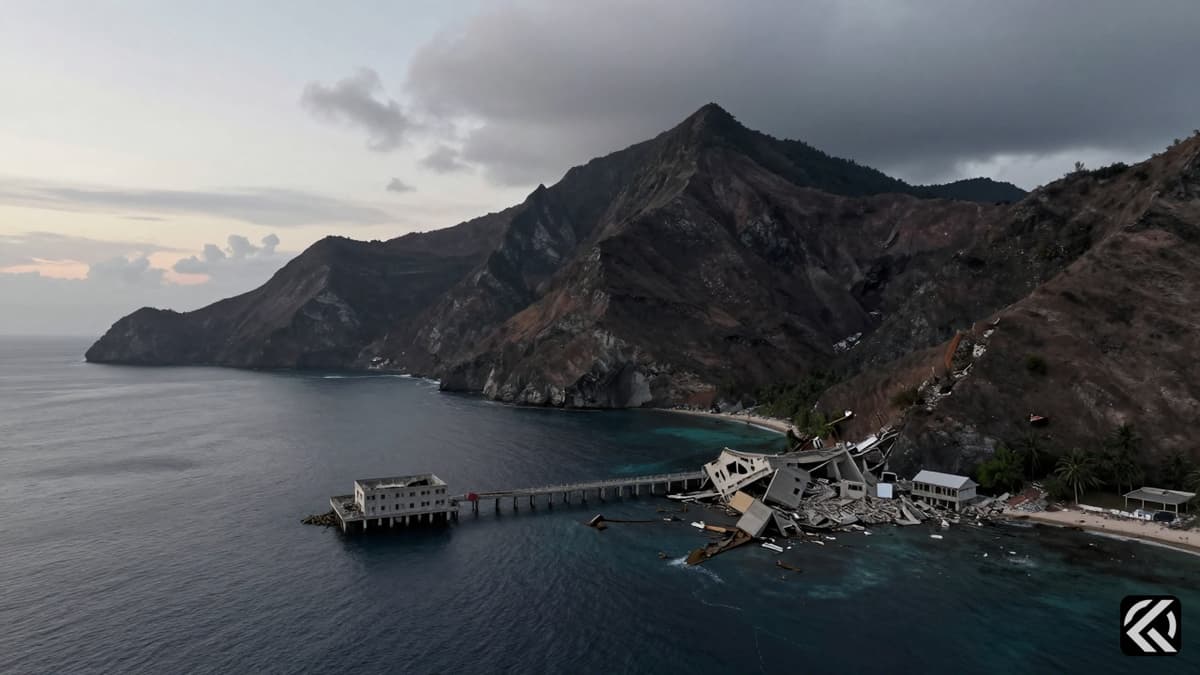
The rescue teams in Indonesia have been searching for survivors of Saturday's major earthquake which left at least 47 people dead. The magnitude 7.7 quake struck the island of Flores shortly before 05:00 local time, corresponding to 22:00 GMT on Friday. Indonesia's meteorology and geophysics agency stated that the tremor had a depth of 15km. Preliminary reports indicate hundreds of buildings have been severely damaged by the quake and the dozens of aftershocks that followed. However, the full scale of the disaster is still unclear, and news of a second earthquake of magnitude 6.9 at the other end of Indonesia served as a reminder of why they call this region the ring of fire.
Tremors from Saturday's powerful earthquake were reportedly felt by residents as far west as Bima Regency and City, the National Disaster Management Agency (BNPB) agency said, but the Manggarai province is among the most affected. Preliminary data shows that 24 fatalities had been recorded there, meanwhile 17 deaths were recorded in East Manggarai province, three in Sikka province, and at least one in each of the Ngada, Ende and West Manggarai provinces. The BNPB said aid was being sent to the affected areas with 10,500 packages arriving at the base operations so far. It will take time to assess the full extent of the destruction in the region, which is remote and mountainous.
However, early reports indicate more than 150 houses had been severely damaged, as well as dozens of educational institutions, a number of healthcare facilities, places of worship, offices, and several other public facilities. Video taken at the port in Maumere - the largest town in Flores - showed large chunks of concrete breaking off the terminal building onto passengers waiting to board an inter-island ferry. Some were thrown into the sea when the gangway to a ship collapsed. Emanuel Melkiades Laka Lena, governor of East Nusa Tenggara province, told a news conference that they were killed in their sleep by collapsing rubble. Others, like Arnold Welianto, who lives in Talibura, a village near the coastline in Sikka, East Nusa Tenggara, were shaken out of their beds. He also told the BBC that many people had already fled into the hills because the sea had also receded. While a tsunami warning was initially issued - leading some 2,000 people to self-evacuate - it was lifted around three hours after the initial jolt, when no significant sea level rise was detected.
A devastating magnitude 7.7 earthquake has struck the Indonesian island of Flores, claiming at least 47 lives and causing widespread destruction.
The immediate aftermath of the Flores earthquake has revealed a complex challenge for emergency responders. The region's geography, characterized by remote and mountainous terrain, complicates the logistical efforts required to assess damage and deliver assistance. The National Disaster Management Agency (BNPB) has initiated a significant relief operation, dispatching 10,500 aid packages to base operations in the affected zones. Despite this rapid response, the full extent of the infrastructure damage remains difficult to quantify due to the inaccessibility of many villages.
The death toll, currently standing at 47, is concentrated in specific provinces, with Manggarai and East Manggarai suffering the highest number of casualties. The governor of East Nusa Tenggara province noted that many victims succumbed to collapsing rubble while asleep, highlighting the suddenness of the event which occurred in the early morning hours. This timing, combined with the severity of the shaking, contributed to the high loss of life. Arnold Welianto, a resident of Talibura in Sikka, described being shaken from his bed, illustrating the intensity of the tremors even in areas slightly further from the epicenter. The receding sea prompted some residents to flee to higher ground, although the subsequent tsunami warning was lifted after three hours due to the lack of significant sea level rise.
The structural damage extends beyond residential homes. Dozens of educational institutions, healthcare facilities, and places of worship have been reported severely damaged or destroyed. In Maumere, the largest town on Flores, the port infrastructure suffered catastrophic failure, with concrete debris falling onto passengers and gangways collapsing. These incidents underscore the vulnerability of critical public infrastructure in the region. The magnitude 7.7 tremor, combined with numerous aftershocks, has left a trail of destruction that will require substantial resources to repair.
The geological context of this disaster is significant. Indonesia's location on the Pacific Ring of Fire makes it prone to frequent seismic activity. The occurrence of a secondary 6.9 magnitude earthquake at the opposite end of the archipelago shortly after the main event serves as a stark reminder of the region's tectonic instability. This dual seismic activity highlights the need for robust, nationwide disaster preparedness and response mechanisms. While the immediate tsunami threat has passed, the potential for further aftershocks and secondary disasters, such as landslides in the mountainous regions, remains a critical concern for relief agencies and local authorities.
The devastating Flores earthquake and the subsequent secondary tremor underscore the persistent geological risks facing Indonesia. With the death toll at 47 and hundreds of structures damaged, the immediate focus remains on search and rescue operations in the remote, mountainous terrain of East Nusa Tenggara. The rapid deployment of aid packages by the BNPB demonstrates an active response, but the logistical challenges of the region will prolong the recovery process. The collapse of key infrastructure, including ports, schools, and hospitals, will have long-term socioeconomic implications for the local population, disrupting education, healthcare, and commerce. As authorities continue to assess the full extent of the damage, the community's resilience will be tested by the need to rebuild in an area defined by its volatile tectonic activity.
Oct 3, 2026 04:08 UTC
FlyDubai Co-Pilot Banned in Oman Over Extremism Concerns
Oct 3, 2026 00:50 UTC
Israel-Mumbai Campaign Honors Captain Smit After Flydubai Incident
Oct 2, 2026 18:13 UTC
Captain Smit Machchhar’s Courage Saves Flydubai Flight FZ1073 From Disaster
Oct 2, 2026 16:45 UTC
Captain Smit Machchhar Saves Plane Mid-Fall
Oct 3, 2026 10:04 UTC
UAE Official: Flydubai Co-Pilot’s Attack Was Terror Act