In a significant political development, senior BJP leaders approached the Election Commission to demand stringent measures against the Congress president for his controversial statements.
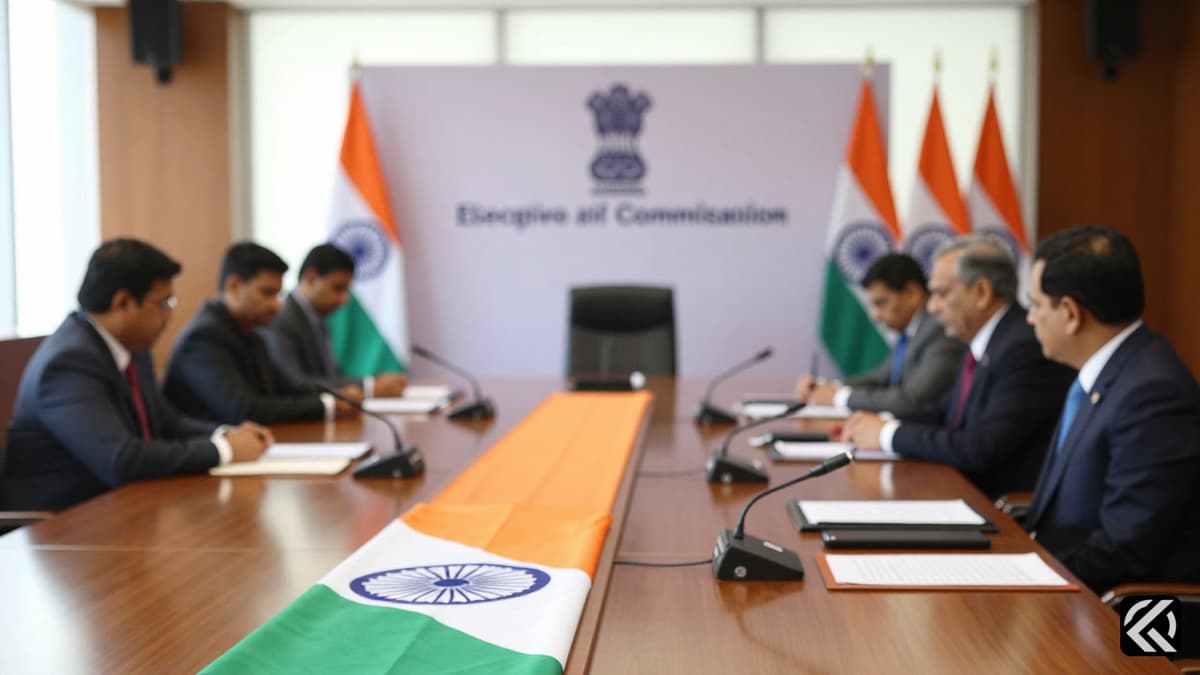
In a direct challenge to electoral decorum, a BJP delegation comprising three Union ministers visited the Election Commission of India on Wednesday, April 22, 2026. The primary objective of this high-level visit was to demand the "strictest action" against Congress president Mallikarjun Kharge. The controversy stems from a specific remark made by Kharge, which the BJP leadership described as a "terrorist" comment targeting Prime Minister Narendra Modi.
Speaking to reporters immediately following the session, Finance Minister Nirmala Sitharaman outlined the gravity of the delegation's presentation. She stated that they appeared before the full commission to formally bring the issue to its notice. Sitharaman emphasized the seniority of the accused individual, noting that "no less a person than the president of the Congress and the leader of opposition in the Rajya Sabha" had spoken in such "condemnable words." The delegation's approach underscores a significant escalation in political rhetoric, prompting immediate calls for regulatory intervention.
The meeting was conducted on a formal Wednesday, highlighting the urgency with which the ruling party viewed the allegations. The delegation, representing a major section of the political spectrum, sought to ensure that the Election Commission of India took cognizance of the statement. By addressing the "full commission," the BJP aimed to secure a collective and authoritative response to what they termed a violation of acceptable political discourse. The specific nature of the remark, described by the delegation as targeting the Prime Minister with terminology reminiscent of "terrorist" acts, formed the core of their petition.
Sitharaman's briefing to the media served as a public record of the meeting's outcome. Her statement focused on the position of the individual in question, reiterating that the President of the Congress party, who also holds the title of Leader of the Opposition in the Rajya Sabha, was the subject of the complaint. The language used in the complaint suggests that the BJP views the remark not merely as a political disagreement, but as a breach of conduct warranting severe consequences. The demand for "strictest action" implies that the delegation believes the standard procedures or warnings might be insufficient given the severity of the "condemnable words" used.
The context of the meeting reveals a tense political environment where the boundaries of permissible speech are being tested. The involvement of a Union minister in such a direct appeal to the electoral body indicates the seriousness with which the BJP treats the protection of the Prime Minister's reputation. The delegation's choice to approach the full commission rather than a single official suggests a desire for a comprehensive review of the matter. The timing, early in the day on Wednesday, allows for immediate administrative consideration of the request for stricter enforcement mechanisms.
The interaction between the BJP leadership and the electoral watchdog marks a critical moment in the ongoing political narrative. By explicitly naming the "leader of opposition" and referencing the "condemnable words," the delegation has placed the matter squarely within the jurisdiction of the Election Commission of India. The use of the term "terrorist" to describe a remark, even indirectly through the delegation's framing, elevates the incident from a standard political exchange to a matter of national security and electoral integrity. The delegation's insistence on the "strictest action" suggests a belief that the current regulatory framework may not automatically penalize such behavior without explicit prompting from affected parties.
This development is likely to trigger further discussions regarding the limits of political speech during election cycles or periods of heightened political activity. The explicit demand for action against the head of the opposition party signals a shift towards more aggressive political accountability measures. As the full commission reviews the delegation's concerns, the potential outcomes could range from formal warnings to more stringent punitive measures, depending on the interpretation of the remarks. The immediate reaction from the BJP, as detailed by Nirmala Sitharaman, sets a precedent for how future disputes of this nature might be handled, emphasizing the role of the electoral body in maintaining the sanctity of the democratic process. The focus remains on the specific incident involving Prime Minister Narendra Modi and the subsequent demand for justice through the established electoral channels.
The delegation's urgent plea sets a significant precedent for how the Election Commission of India may handle future instances of alleged inflammatory political speech. Given the explicit demand for "strictest action," there is a growing expectation that the commission will move beyond mere observation to active intervention. If the commission decides to act, it could signal a tightening of norms regarding the language used by high-ranking officials, potentially influencing the tone of political debates across the country. The long-term impact may include a more cautious approach by opposition leaders when discussing the Prime Minister, aiming to avoid similar controversies. Conversely, the ruling party may view this as a successful assertion of their stance on maintaining decorum, strengthening their position in future electoral narratives. The immediate aftermath will depend on the commission's interpretation of the "condemnable words" and the subsequent administrative steps taken to address the BJP's formal complaint.
Jun 8, 2026 02:17 UTC
Magnitude 7.8 Quake Shakes Philippines, Urging Immediate Evacuations
Join 50,000+ readers getting the global briefing every morning.
No spam. Unsubscribe anytime.
Jun 8, 2026 02:17 UTC
Magnitude 7.8 Quake Shakes Philippines, Urging Immediate Evacuations
Jun 8, 2026 00:51 UTC
Trump Claims Iran Nuclear Deal Imminent Despite Diplomatic Fractures
Jun 8, 2026 00:47 UTC
Iran Fires Missiles at Israel After Beirut Strike
Jun 7, 2026 22:38 UTC
Congress Party Claims Unity for INDIA Bloc Delhi Meeting