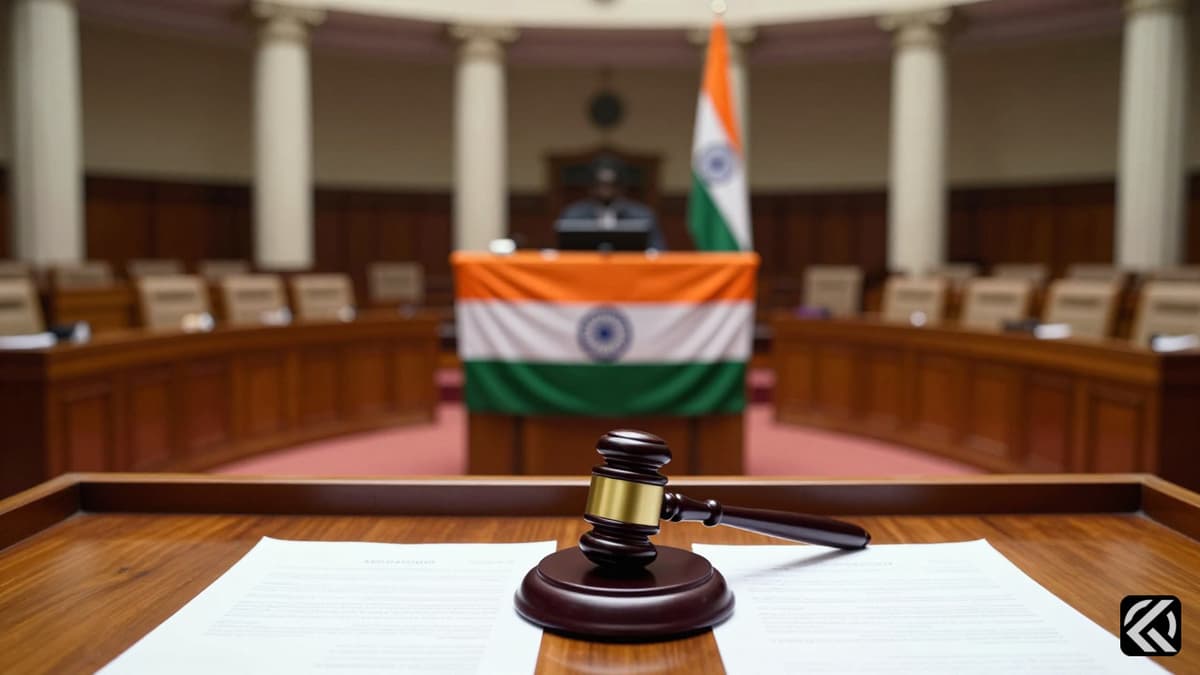
In a historic political shift, Samrat Choudhary assumes the role of Bihar Chief Minister, marking a new chapter for the state under Prime Minister Narendra Modi's influence.
A leader from Indian Prime Minister Narendra Modi's Bharatiya Janata Party (BJP) has officially taken oath as the new chief minister of the eastern state of Bihar. This significant political development occurs immediately after veteran politician Nitish Kumar stepped down from the position. The transition marks a pivotal moment for the state, ending a two-decade era where Kumar, representing the BJP's ally Janata Dal (United), remained chief minister for the most part. While Kumar had often switched political alliances to maintain power, the current appointment sees a new face rising to the challenge.
The 57-year-old Samrat Choudhary now faces the daunting task of filling big shoes left by Kumar, who was one of Bihar's most influential leaders. Bihar remains India's poorest state, home to more than 74 million voters, with millions of its citizens migrating to other parts of India for employment. Historically, this was also one of the few states in India where the BJP had not managed to form a government on its own, yet Samrat Choudhary's elevation changes this dynamic. The 75-year-old Kumar was elected to the Upper House of parliament just last month, a move that had been anticipated for a while due to his deteriorating health.
Ravi Shankar Prasad, a prominent BJP leader, addressed reporters earlier to mark the occasion. He stated, "Bihar has changed and I must acknowledge that and give him [Kumar] due respect... Now Samrat Choudhary is set to become the chief minister. This is a big and historic day." The sentiment underscores the magnitude of the transition, suggesting that the political landscape of the state is undergoing a fundamental transformation.

Choudhary, who belongs to a well-established political family, enters the role with a career spanning more than three decades. His father, Shakuni Choudhary, served as a legislator in Bihar for more than two decades starting in the mid-1980s. His mother, Parvati Devi, was a social activist who turned politician and was also elected as a legislator once. Choudhary is widely recognized as a prominent leader from a caste group that is part of the Other Backward Class (OBC). These communities are identified by the government as socially and economically disadvantaged, and they form a significant share of the electorate in Bihar, where caste remains a central factor in politics.
His political journey has seen him navigate a complex web of party affiliations. He was once a member of the Rashtriya Janata Dal (RJD), which is Bihar's main opposition party. He joined Kumar's JD(U) in 2014 but left in 2017 to join the BJP, at a time when Kumar himself had realigned with the BJP after breaking with his previous allies. After Kumar switched alliances again in 2022, Choudhary became one of his vocal critics. However, the political winds shifted again when the BJP and JD(U) renewed their alliance in 2024. In this renewed partnership, Choudhary patched ties with the veteran leader, eventually rising to become deputy chief minister.
During his tenure under Kumar's government, Choudhary also served as home minister, a role that oversees the state's police force and is considered one of the most influential departments in the state's administration. His elevation to the top post signals the BJP's efforts to broaden its social base in the state. Some analysts argue that this move will pay dividends in the future, particularly given his background in the OBC community. However, not all views are unanimous. Others have argued that he does not come from the BJP's traditional organizational structure and have questioned his suitability for the top role.
Despite the internal questions, the appointment solidifies the BJP's first direct control over the chief ministership in Bihar, a state that has long been a stronghold of other political dynamics. The shift from a multi-year tenure by Kumar to a BJP leader represents a major milestone in the party's expansion. With the state's economy facing challenges and high migration rates for jobs, the new leadership must navigate a difficult path to stability. The transition has been framed as a historic day for the party, signaling a new era for the state's governance.
The appointment of Samrat Choudhary as Bihar Chief Minister represents a definitive turning point in the state's political history, signaling the BJP's successful entry into a role it previously could not hold independently. While the transition is driven by Nitish Kumar's decision to leave for the Upper House due to health reasons, the strategic placement of a leader from the OBC community suggests a calculated effort to consolidate support among socially disadvantaged groups. Looking ahead, the new administration faces the dual challenge of addressing economic disparities in India's poorest state while managing the expectations of a populace accustomed to long-standing political dynasties. The long-term impact of this shift will likely depend on Choudhary's ability to balance his party's national agenda with the specific, deeply rooted caste and social dynamics that define Bihar's electorate.
Jun 8, 2026 02:17 UTC
Magnitude 7.8 Quake Shakes Philippines, Urging Immediate Evacuations
Join 50,000+ readers getting the global briefing every morning.
No spam. Unsubscribe anytime.
Jun 8, 2026 02:17 UTC
Magnitude 7.8 Quake Shakes Philippines, Urging Immediate Evacuations
Jun 8, 2026 00:51 UTC
Trump Claims Iran Nuclear Deal Imminent Despite Diplomatic Fractures
Jun 8, 2026 00:47 UTC
Iran Fires Missiles at Israel After Beirut Strike
Jun 7, 2026 22:38 UTC
Congress Party Claims Unity for INDIA Bloc Delhi Meeting