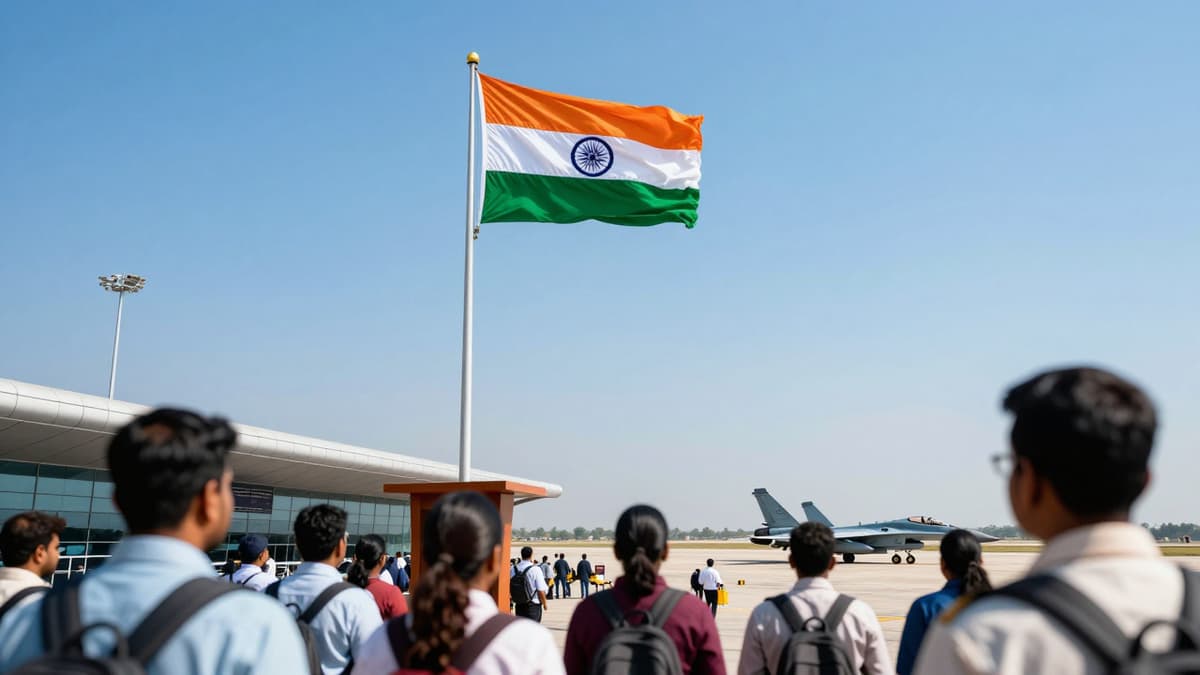
Prime Minister Narendra Modi directly targets the opposition during a visit to Gujarat, alleging the Congress party is exploiting the West Asia energy crisis to incite public disorder.
Prime Minister Narendra Modi addressed a large gathering in Nani village on Tuesday, March 31, 2026, launching a sharp attack on the opposition while discussing national resilience. He accused the Congress party of acting like "vultures of politics" by attempting to exploit the unfolding West Asia conflict for electoral advantage. Asserting that India has managed the situation efficiently, the Prime Minister claimed that opposition leaders are actively spreading fear and rumors to trigger panic among citizens.
Modi alleged that these political rivals are engaging in rumour-mongering to incite public disorder, specifically by trying to persuade people to queue up at fuel pumps. While the nation faces a global crisis involving the U.S.-Israel-Iran war, Modi stated that India stands united and resilient despite difficulties with energy requirements. He pointed out that while many countries are engulfed in war and unrest, India has successfully kept the situation under control through strong foreign policy and citizen solidarity.
The Prime Minister highlighted that fuel prices have surged by 10 to 25% in many nations, yet India has protected its people from the worst impact. He argued that the Congress party finds this outcome intolerable and is spreading rumors to create an atmosphere of fear. Their objective, according to Modi, is to cause chaos by making people queue in panic at petrol pumps and gas agencies, allowing them to exploit the public disorder for their own propaganda.
During this visit, the Prime Minister also addressed the history of the Deesa airbase, a strategically critical project situated merely 130 kilometers from the international border. He asserted that the project was stalled for years due to the attitude of the previous Congress-led governments at the Centre. Modi noted that while the project was conceptualized during his tenure as Gujarat chief minister with willing farmer land contributions, it remained buried in bureaucratic files under the old administration.
Gaining momentum only after the current government took power, the site is now a massive Air Force base that will serve as a catalyst for regional development. Modi emphasized that the nation will never forgive the opposition for their utter apathy towards national security when they were in power. He described the new infrastructure as a crucial component for strengthening India's western frontier.
The Prime Minister used this opportunity to criticize the opposition for trying to score political points during a global crisis, calling it unfortunate behavior. He reiterated that the West Asia energy crisis has intensified global difficulties regarding diesel, petrol, and gas, but India's collective strength has ensured stability. He stressed that while the opposition wants to spread anarchy, India is capable of facing any crisis and will emerge as a world leader in the renewable energy sector.
Referring to the current status of the region, Modi mentioned that this was his maiden visit to the newly created Vav Tharad district, carved out from Banaskantha in October 2025. At the event, he laid foundation stones and inaugurated development projects totaling ₹19,806.9 crore. This included ₹10,921 crore under Union Ministries and ₹8,886 crore under Gujarat Government departments.
Key initiatives launched included the ₹3,645 crore Khavda Renewable Energy Park in Kutch, aimed at integrating large-scale renewable energy into the national grid. In the road sector, foundation stones were laid for the Idar-Badoli bypass and the Dholavira-Santalpur stretch. Additionally, multiple packages of the Ahmedabad-Dholera corridor were inaugurated to improve connectivity.
Railway projects worth ₹891 crore, including the Himmatnagar-Khedbrahma broad gauge line and track expansion works in Kutch and Saurashtra, were also launched. The Prime Minister flagged off the Khedbrahma-Himmatnagar-Asarva train, marking a significant improvement in rail connectivity for the region. Through these actions, the government aims to demonstrate that despite external pressures from the global conflict, domestic development and national security remain uncompromised.
The Prime Minister's visit underscores a dual strategy of addressing political narratives while accelerating tangible infrastructure growth in Gujarat. By highlighting the rapid completion of the Deesa airbase, the administration seeks to demonstrate that national security projects can no longer be delayed by bureaucratic inertia. Looking forward, the integration of the Khavda Renewable Energy Park into the national grid suggests a long-term commitment to energy independence, potentially insulating India from future price shocks associated with the West Asia energy crisis. As the region develops into a strategic hub, the focus on renewable energy and transport connectivity may establish a blueprint for balancing economic resilience with defensive preparedness in a volatile geopolitical landscape.
Jun 8, 2026 02:17 UTC
Magnitude 7.8 Quake Shakes Philippines, Urging Immediate Evacuations
Jun 8, 2026 00:51 UTC
Trump Claims Iran Nuclear Deal Imminent Despite Diplomatic Fractures
Jun 8, 2026 00:47 UTC
Iran Fires Missiles at Israel After Beirut Strike
Jun 7, 2026 22:00 UTC
US, Iran Peace Hops Fade 100 Days Into War
Jun 8, 2026 04:15 UTC
Trump Urges Netanyahu to Halt Iran Strike for Peace


