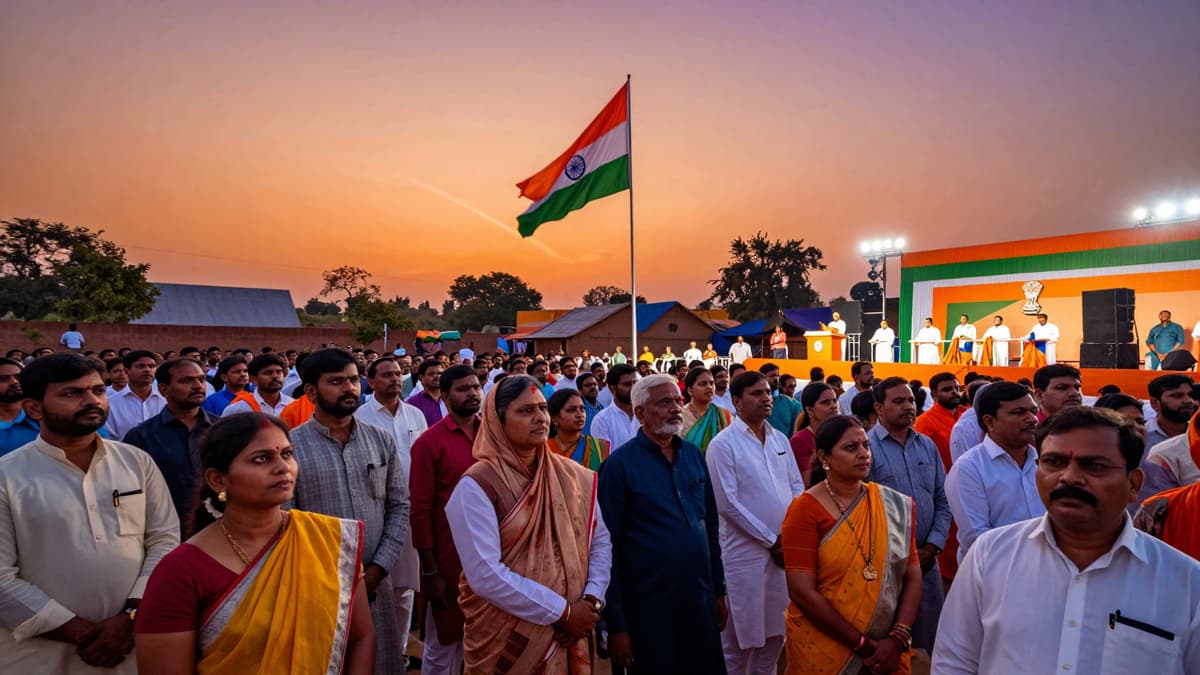
Prime Minister Narendra Modi on March 31, 2026, condemned Congress for exploiting the West Asia conflict to incite panic, asserting India's resilience against global energy shocks.
Prime Minister Narendra Modi addressed a massive gathering in Nani village on Tuesday, March 31, 2026, to discuss the ongoing geopolitical tensions. He sharply criticized the Opposition, alleging they are attempting to exploit the West Asia conflict for political gain. Asserting that the nation has managed the situation efficiently, the Prime Minister warned against spreading panic.
Addressing the crowd in the newly created Vav Tharad district, Mr. Modi accused the Congress party of indulging in rumor-mongering and inciting public disorder. He stated that while the nation requires unity during crises, Congress leaders are actively engaged in divisive politics. The Prime Minister highlighted that the Opposition is busy spreading fear rather than providing reassurance, aiming to trigger panic among the people.
Mr. Modi drew a sharp parallel between the political behavior of the Congress and scavenging birds, coining the phrase "Rajneeti ke Gidh" to describe their approach. He explained that the party is waiting for escalation of domestic troubles to exploit the situation and reap political dividends. He noted that while many nations are engulfed in war and instability, India has demonstrated unique resilience and unity.
The Prime Minister acknowledged the global situation triggered by the U.S.-Israel-Iran war has widespread repercussions, particularly on energy supplies. He admitted that difficulties regarding energy requirements for diesel, petrol, and gas have intensified globally. However, he asserted that despite these global challenges, India has successfully kept the situation under control. He credited this stability to strong foreign policy and the collective strength of its citizens.
Mr. Modi further emphasized India's potential to emerge as a world leader in the renewable energy sector. He criticized the Opposition for wanting to spread anarchy, asserting that India is capable of facing any crisis. He specifically attacked the Congress for trying to instigate people to queue up at fuel pumps, which he argued was intended to spread disorder. He stated that attempts to score political points during a global crisis are unfortunate, with the Congress party at the forefront of this alleged political conspiracy.
The Prime Minister also shifted focus to a specific project delay, blaming previous Congress-led governments at the Centre for hindering the development of the Deesa airbase. He revealed that his aircraft landed directly at the Deesa airbase during his visit, noting its strategic location just 130 kilometres from the international border. He described the project as crucial for national security, which had been buried in bureaucratic files for years.
Mr. Modi explained that the airport project was conceptualized during his tenure as Gujarat chief minister, with farmers willingly contributing their land. However, he claimed the project remained stuck due to the "attitude and approach" of the central government at the time. He stated that the project only gained momentum after his government came to power at the Centre. He declared that a massive Air Force base has now been established in Deesa, serving as a catalyst for regional development and strengthening India's western frontier.
On this occasion, Mr. Modi inaugurated and laid foundation stones for development projects totaling ₹19,806.9 crore. This massive infrastructure push included ₹10,921 crore under Union Ministries and ₹8,886 crore under Gujarat Government departments. Among the key initiatives, he inaugurated projects worth ₹3,645 crore linked to the Khavda Renewable Energy Park in Kutch, aimed at integrating large-scale renewable energy into the national grid.
In the road sector, foundation stones were laid for the Idar-Badoli bypass and the Dholavira-Santalpur stretch, while multiple packages of the Ahmedabad-Dholera corridor were also inaugurated. Additionally, railway projects worth ₹891 crore were launched, including the Himmatnagar-Khedbrahma broad gauge line and track expansion works in Kutch and Saurashtra. The Prime Minister also flagged off the Khedbrahma-Himmatnagar-Asarva train, marking improved rail connectivity in the region.
This strategic pivot highlights India's aggressive expansion in energy security and border infrastructure. As the nation moves forward, the focus on renewable energy integration and the completion of the Deesa airbase suggests a long-term strategy to bolster national resilience against future global disruptions. The Prime Minister's assertion that India will emerge as a world leader in renewable energy, combined with the completion of critical military infrastructure, indicates a sustained effort to reduce dependency on volatile global markets. The political rhetoric surrounding the "West Asia energy crisis" suggests that future policy debates will heavily center on maintaining domestic price stability while expanding clean energy capabilities, ensuring that economic security remains a priority regardless of international geopolitical turbulence.
Jun 8, 2026 04:15 UTC
Trump Urges Netanyahu to Halt Iran Strike for Peace
Join 50,000+ readers getting the global briefing every morning.
No spam. Unsubscribe anytime.
Jun 8, 2026 02:28 UTC
Trump Walks Out of Meet the Press After Rejecting Evidence Demands
Jun 8, 2026 02:17 UTC
Magnitude 7.8 Quake Shakes Philippines, Urging Immediate Evacuations
Jun 8, 2026 00:51 UTC
Trump Claims Iran Nuclear Deal Imminent Despite Diplomatic Fractures
Jun 8, 2026 00:47 UTC
Iran Fires Missiles at Israel After Beirut Strike


