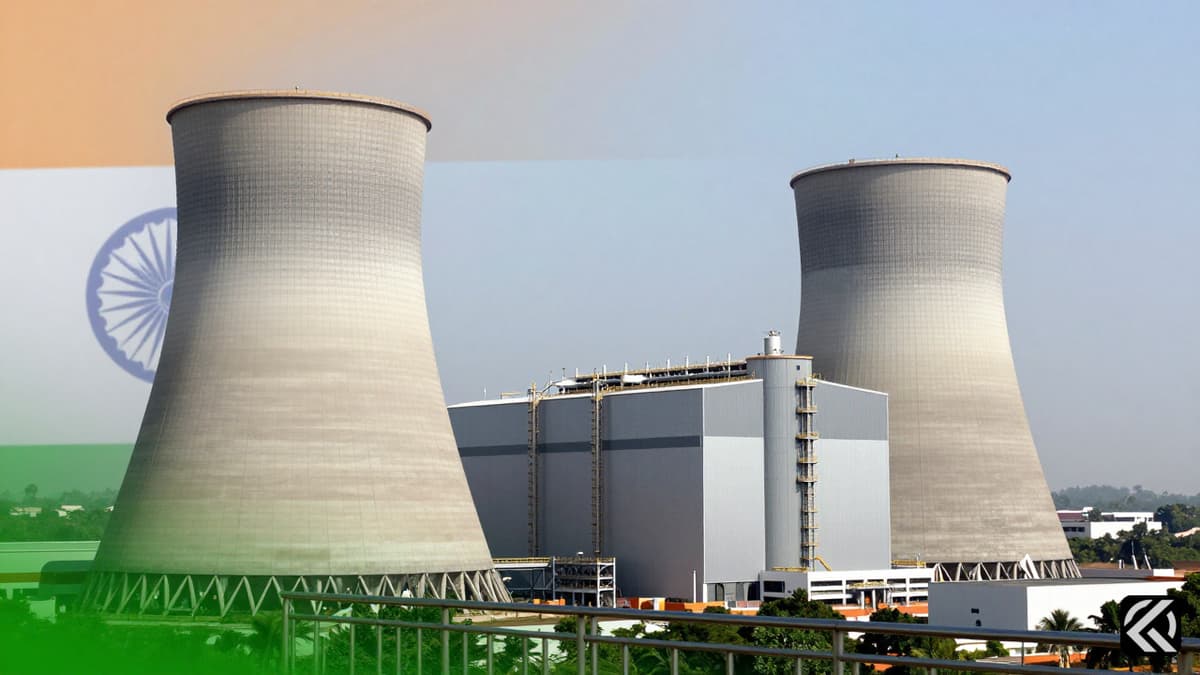
India marks a nuclear leap as its prototype fast breeder reactor reaches criticality, promising to revolutionize energy production by unlocking vast thorium reserves.
India's most advanced nuclear reactor has reached a self-sustaining stage that marks a major leap for the country's atomic energy programme, and takes it a step closer to cutting dependence on uranium. The prototype fast breeder reactor (PFBR) at Kalpakkam in the southern Indian state of Tamil Nadu reached criticality-the stage at which a nuclear chain reaction can continue on its own-on Monday. Once the reactor becomes fully operational, India will become only the second country after Russia to have a commercial fast breeder reactor.
Indian Prime Minister Narendra Modi called it "a proud moment for India" and "a defining step" in advancing the country's nuclear programme. He stated in a post on X that this advanced reactor, capable of producing more fuel than it consumes, reflects the depth of India's scientific capability. It is a decisive step towards harnessing India's vast thorium reserves in the third stage of the programme.
The fast breeder reactor is an advanced nuclear system designed and developed by the Indira Gandhi Centre for Atomic Research (IGCAR) under the Department of Atomic Energy. With a capacity of 500 megawatts electrical (MWe), it functions differently from the pressurised heavy water reactors currently used by India and most other countries. While standard reactors use uranium as fuel and churn out plutonium as waste, the PFBR uses that ejected plutonium to set in motion a self-sustaining nuclear reaction. This design means the reactor requires less uranium to generate electricity than heavy water reactors do, effectively producing more fissile material than it consumes.
On Monday, the Indian government noted that the reactor is designed to enable India to extract greater energy from its limited uranium reserves while paving the way for large-scale deployment of thorium-based reactors. A March 2024 report from the Prime Minister's office explained that the PFBR will initially use Uranium-Plutonium Mixed Oxide (MOX) fuel. As the Uranium-238 blanket surrounding the fuel core undergoes nuclear transmutation, it produces more fuel, earning the name "Breeder." This process also offers a significant reduction in nuclear waste, avoiding the need for large geological disposal facilities.
However, not all experts are convinced that the economics will favor this technology. MV Ramana, a professor at the University of British Columbia, noted that the history of breeder reactors worldwide has been troubled by inherent technical characteristics resulting in low efficiencies. He pointed out that the PFBR cost more than twice its initial estimate, and even at the original cost, electricity would have been 80 percent more expensive than pressurised heavy water reactors. Now, electricity from the PFBR is far more expensive than alternatives, including solar energy.
The strategic importance of this reactor lies in its role within India's three-stage nuclear programme. In the second stage, the PFBR uses uranium and plutonium waste to generate electricity while producing plutonium and uranium-233. These products serve as fuel for third-stage reactors. Those future reactors will be thorium nuclear programme based, fed with thorium-which India possesses in abundance, holding more than 25 percent of the world's supply-and uranium-233. Once this cycle is complete, India would significantly reduce its need for naturally found uranium.
Construction of the PFBR officially began in 2004 after multiple delays. Its importance was highlighted by scientists in an October 1996 report for the International Atomic Energy Agency, citing India's growing demand for electricity as the world's third-largest energy consumer. With the world's largest population and a fast-growing economy, energy consumption is expected to rise further. The government aims to raise nuclear energy's share from 3 percent currently to 100 gigawatts by 2047, down from 8,180MW in 2024.
Paul Norman, a professor at the University of Birmingham, explained that the technology can increase nuclear fuel reserves enormously by theoretically making use of all uranium via plutonium conversion. Additionally, the system can be tweaked toward thorium systems, leveraging the fact that global thorium reserves are four times larger than uranium reserves. If India successfully turns this prototype success into a commercial model, it could inspire other nations to follow suit.
MIT professor Koroush Shirvan cautioned against overemphasizing India's achievement without context, noting it took over 20 years since construction started to reach this milestone. He contrasted this with China, which built a slightly larger plutonium fast breeder reactor in just six years. Shirvan argued that India needs to scale its nuclear energy programme much faster to make a meaningful impact in its energy sector.
The global context also presents challenges. Professor Ramana highlighted that nuclear energy is declining in importance, with its share of electricity dropping from 17.5 percent in 1996 to only 9 percent in 2024. In contrast, modern renewables excluding large hydroelectric dams produced 17.3 percent of the world's electricity, up from around one percent in the mid-1990s. If the high costs and delays in bringing the PFBR to criticality serve as a lesson, it may discourage the rest of the world from investing time and resources in fast breeder reactors. As India moves forward, the balance between technological ambition and economic reality will remain a critical factor in determining the future of its atomic energy landscape.
Jun 8, 2026 00:51 UTC
Trump Claims Iran Nuclear Deal Imminent Despite Diplomatic Fractures
Jun 8, 2026 00:47 UTC
Iran Fires Missiles at Israel After Beirut Strike
Jun 7, 2026 22:00 UTC
US, Iran Peace Hops Fade 100 Days Into War
Jun 7, 2026 20:57 UTC
Iran Strikes Israel: IRGC Promises Week of Continuous Offensive
Jun 8, 2026 02:28 UTC
Trump Walks Out of Meet the Press After Rejecting Evidence Demands


