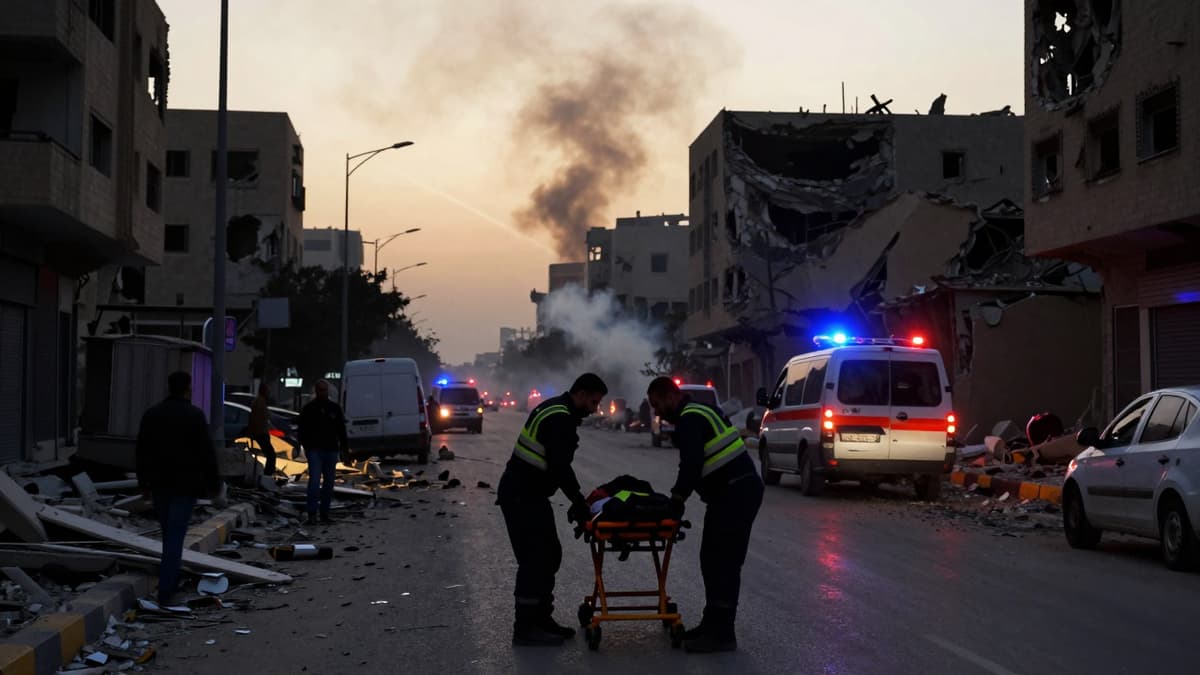
On Day 28, a devastating Iran missile strike injured US troops in Saudi Arabia while cluster munitions Tel Aviv targets killed civilians.
In the 28th day of the Middle East conflict, US service members sustained injuries during an attack on Prince Sultan Air Base in Saudi Arabia, while a separate Iran missile strike damaged buildings and injured civilians in central Israel. The coordinated attacks, occurring late Friday night, mark a sharp escalation in the region as the war continues to claim lives across multiple nations.
Reuters footage captured the immediate aftermath in Tel Aviv, showing debris scattered across streets and damaged shops in the Givatayim district. Shay Tiram, the head of the Givatayim police station, confirmed "several impact sites" were identified shortly before midnight local time, though he initially reported no casualties in that specific area. However, other reports contradict this, with CNN teams witnessing cluster munitions Tel Aviv targets exploding in the sky, resulting in at least one fatality and four injuries according to the national emergency service.
The US response has been robust. A US official confirmed to CNN that an Iranian attack specifically injured at least 10 service members at the Saudi base. This incident brings the total number of US service members killed since the start of the war to 13. Meanwhile, President Donald Trump, speaking at the Future Investment Initiative summit in Miami, asserted that the conflict is not finished. He stated there are another 3,554 targets left to hit in Iran, promising action would be taken "pretty quickly." Trump also noted a "legal reason" for classifying the situation as a "military conflict" rather than a war, while suggesting the US might scale back spending to protect NATO allies who he claims are not supporting the US sufficiently.
The humanitarian cost of the conflict has reached staggering levels. The Iranian Red Crescent reported that since February 28, at least 1,900 people have been killed in Iran, with 20,000 more injured. Maria Martinez, head of the delegation, shared harrowing accounts from the ground, describing how paramedics rescuing survivors from flattened buildings have discovered the bodies of their own family members. The US and Israeli strikes in western Iran specifically targeted nuclear facilities, including the Bushehr nuclear power plant, which was struck by a projectile late Friday night. This marks the third attack on the facility in recent days. In response, Iran's Foreign Minister Abbas Araghchi condemned the strikes, threatening a "HEAVY price for Israeli crimes."
Across the border in Lebanon, the situation remains dire. UNICEF warned that children are trapped in a "relentless cycle of bombardment and displacement," with about 20% of the population displaced, many multiple times since March 2. Over 367,000 school-age children face disrupted education, and UNICEF's Marcoluigi Corsi declared there is "no safe space" for shelter. Israeli strikes have killed 1,142 people and injured 3,315 others in Lebanon, including 122 children and 42 health workers. Aid workers describe the environment as "unpredictable" and "high-risk," with hundreds of thousands of people moving frequently, making relief efforts increasingly difficult.
In Iraq, at least 96 people have been killed, including 13 in the Kurdistan Region. The US and Iraqi officials have agreed to "intensify" defense cooperation while emphasizing a US aim to keep Iraq out of the direct war with Iran. In the Israeli-occupied West Bank, an Iranian missile killed four Palestinians, while settler violence has led to at least five additional deaths. The cumulative toll in the region is immense, with more than 30 people killed in Persian Gulf countries, including many migrant workers, since the escalation began.
The impact on civilians is perhaps most visible in the displacement crisis. In Lebanon, at least 620,000 women and girls, from Lebanese, Palestinian, and Syrian communities, have been forced to flee. UN Women's Gielan El Messiri reported that women are skipping meals to feed their children, and older women cannot access medication for chronic conditions. Families have been displaced into improvised shelters where newborns lack adequate medication, and psychological trauma is widespread.
The grim reality of the cluster munitions Tel Aviv strike and the broader Iran missile strike campaign is etched into the statistics of death and injury. With the US stating it will scale back defense spending for NATO allies and President Trump vowing to finish the "military conflict," the outlook remains volatile. The convergence of strikes on nuclear facilities, civilian residential areas, and aid routes suggests a continued high-intensity phase. If negotiations fail to materialize this week as US special envoy Steve Witkoff anticipates, the Middle East conflict casualties are poised to rise further, threatening to collapse remaining humanitarian infrastructure and extend the cycle of displacement and suffering across the region.
Jun 8, 2026 02:17 UTC
Magnitude 7.8 Quake Shakes Philippines, Urging Immediate Evacuations
Jun 8, 2026 00:51 UTC
Trump Claims Iran Nuclear Deal Imminent Despite Diplomatic Fractures
Jun 8, 2026 00:47 UTC
Iran Fires Missiles at Israel After Beirut Strike
Jun 7, 2026 22:00 UTC
US, Iran Peace Hops Fade 100 Days Into War
Jun 8, 2026 04:15 UTC
Trump Urges Netanyahu to Halt Iran Strike for Peace


