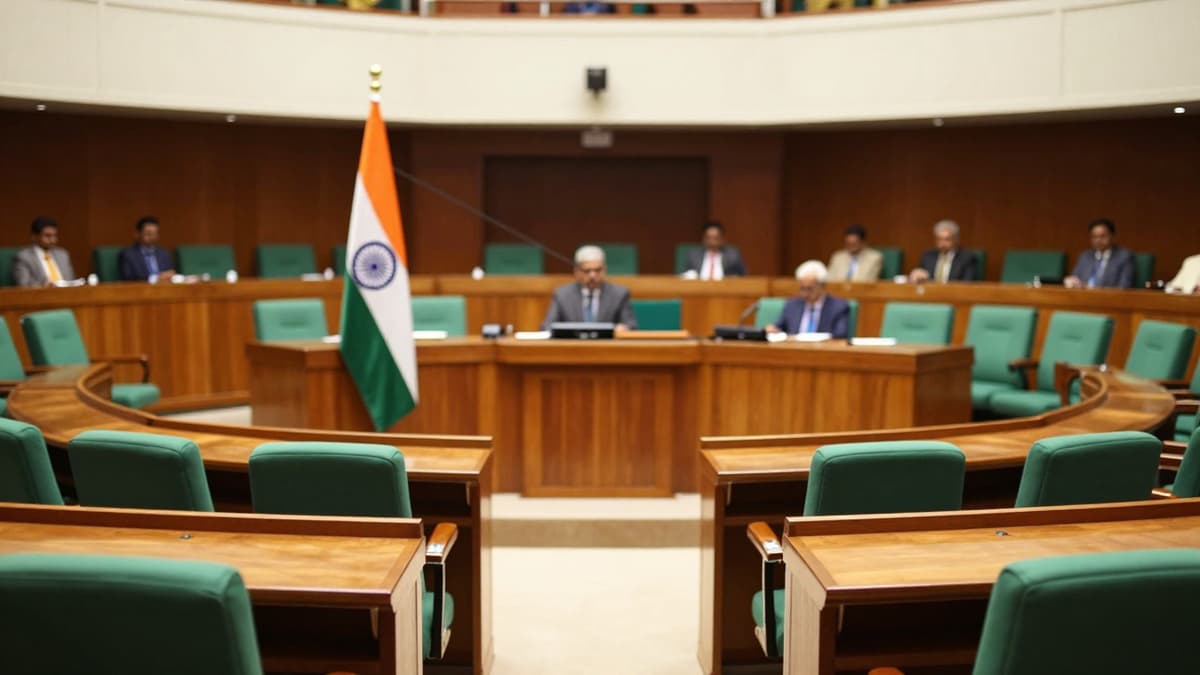
Union Home Minister Amit Shah delivers a stern warning in the Lok Sabha, rejecting dialogue with armed Naxal groups and declaring a hardline stance against Left Wing Extremism.
Union Home Minister Amit Shah delivered a stern address in the Lok Sabha on Monday, firmly rejecting calls for negotiations with Left Wing Extremism (LWE) groups. Speaking while replying to a debate on efforts to eliminate Naxalism, Shah reiterated the government's hardline stance that dialogue is strictly contingent upon the surrender of arms. He argued that current demands for talks ignore the suffering of victims and fail to address the ideological root of the insurgency.
The Home Minister's intervention came amidst a rigorous parliamentary debate regarding the government's decade-long strategy to combat the decades-old menace. Shah challenged the narrative that development demands alone drive the violence, asserting instead that the issue is purely ideological. He pointed out that arguments for dialogue often overlook the human cost of the insurgency. This shift in rhetoric underscores a definitive pivot in the government's approach, moving away from perceived negotiation tactics toward a combined strategy of security and development.
Shah detailed his historical analysis of the movement, stating that the root cause is not a demand for economic development but an ideology that he traced back to 1970. He questioned the shift in tribal allegiance, asking why communities that once revered historical figures like Birsa Munda and Rani Durgawati later adopted Mao as a hero. According to the minister, Leftist groups "tricked the innocent Tribals," preventing them from accessing education and destroying essential infrastructure like schools, banks, and dispensaries. He emphasized that development is now finally reaching the doorsteps of these communities under Prime Minister Modi's rule.

Addressing the scale of the "Red Corridor" that once spanned twelve states, Shah noted that the rule of law had effectively ended in these areas, leaving 12 crore people in poverty. However, he declared that Naxalism has been "almost eradicated" in Bastar, with welfare measures now reaching the people. He cited a massive campaign to establish a school in every village, alongside the distribution of ration shops, PHCs, CHCs, Aadhaar cards, and food grains. He claimed that previously, the region was deprived because of the "shadow of 'Red Terror'."
In a statistical breakdown of the government's crackdown, Shah cited specific figures to underline the success of the security operations. He stated that 4,839 Naxalites have surrendered, while 2,218 have been sent to jail. Furthermore, he reported that 706 individuals who refused to surrender were "gunned down by the police in encounters." Shah insisted that violence cannot be justified under any circumstances and blamed earlier political approaches for allowing the problem to grow. He concluded by asserting that development is now reaching the previously affected areas, signaling a new era of peace.
Prime Minister Narendra Modi responded to the address by praising the Union Home Minister's speech. In a statement, PM Modi called the address "outstanding," noting that it was filled with important facts, historical context, and a clear depiction of the government's efforts over the last decade. He added that for decades, the "retrograde Maoist ideology" had an adverse impact on the development of several regions and ruined the future of countless youngsters. The Prime Minister reiterated that the government has worked towards uprooting this menace while ensuring the fruits of development reach affected areas. He vowed that the government will keep focusing on furthering good governance to ensure peace and prosperity for all.
The Home Minister's address in the Lok Sabha signals a definitive political and strategic shift in how the nation confronts Left Wing Extremism. By framing the issue as purely ideological rather than economic, the government is positioning its security crackdown as a necessary complement to its development agenda. The statistical data presented suggests that the combined strategy of military action and social welfare has yielded tangible results, potentially altering the trajectory of insurgency in the region. Looking ahead, the emphasis on rehabilitation and infrastructure suggests that future policy will likely continue to prioritize rapid development in former conflict zones as the primary tool for long-term peace, provided the security gains remain intact.
Jun 8, 2026 04:15 UTC
Trump Urges Netanyahu to Halt Iran Strike for Peace
Join 50,000+ readers getting the global briefing every morning.
No spam. Unsubscribe anytime.
Jun 8, 2026 02:28 UTC
Trump Walks Out of Meet the Press After Rejecting Evidence Demands
Jun 8, 2026 02:17 UTC
Magnitude 7.8 Quake Shakes Philippines, Urging Immediate Evacuations
Jun 8, 2026 00:51 UTC
Trump Claims Iran Nuclear Deal Imminent Despite Diplomatic Fractures
Jun 8, 2026 00:47 UTC
Iran Fires Missiles at Israel After Beirut Strike