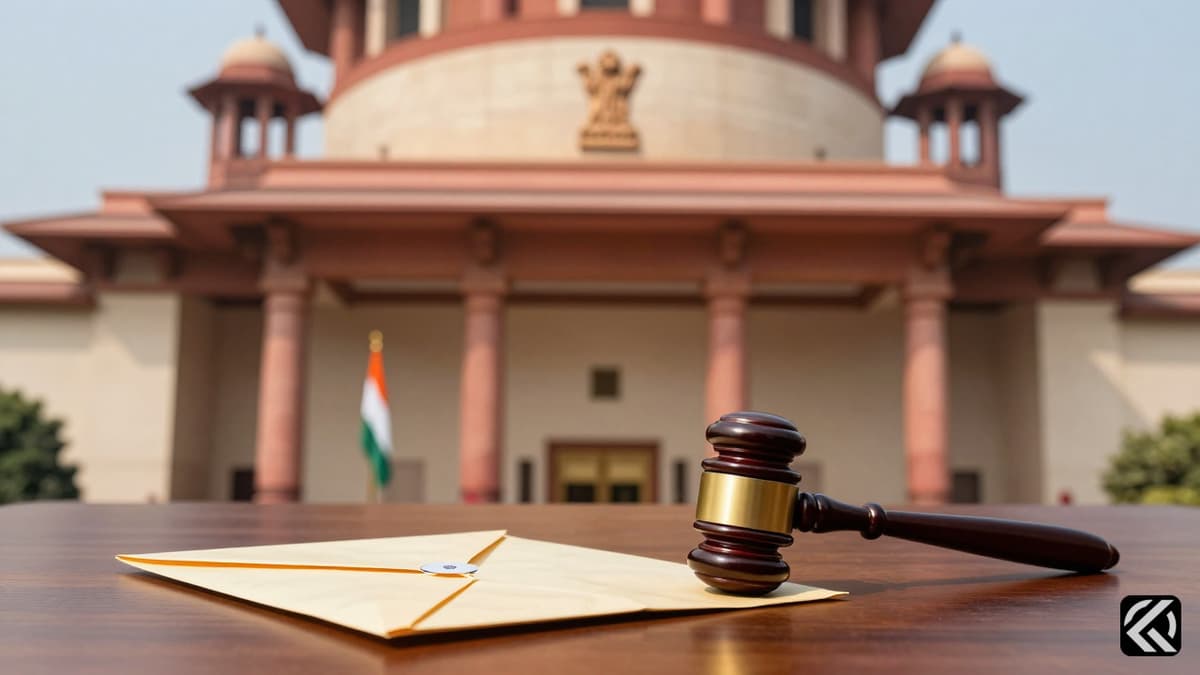
The Supreme Court has directed the National Investigation Agency to take over the West Bengal Special Investigation Review, marking a significant shift amid communication breakdowns and obstruction.
The Supreme Court has issued a definitive directive for the National Investigation Agency to assume control of the investigation into the West Bengal Special Investigation Review (SIR), overriding the state police's current handling of the matter. This drastic measure was ordered by the Chief Justice of India following severe criticisms regarding communication breakdowns and the obstruction of judicial officers by mobs. The bench, comprising Chief Justice of India and Justice Joyamalya Bagchi, recorded that the lack of responsiveness from the West Bengal Chief Secretary and Director General of Police (DGP) had created significant complications during the voting process.
The court's intervention was triggered by a reported inability to contact state officials during critical moments. The Chief Justice of India recounted that even the Chief Justice of the Calcutta High Court was unable to reach the Chief Secretary when judicial officers were gheraoed by an unruly mob. While the Chief Secretary claimed his mobile phone was "secure," Justice Bagchi retorted that the phone should not be so highly secure that the Chief Justice of the High Court cannot access him. The Chief Justice of India further characterized the bureaucracy as "pampered," highlighting a systemic failure in maintaining communication lines during a volatile situation involving the Central Police forces.
In response to the crisis, Senior Advocate Siddharth Luthra, representing the West Bengal Chief Secretary and DGP, informed the Court that state police had already arrested two individuals. However, the Supreme Court records indicate that the custody of these two arrested persons must now be transferred to the National Investigation Agency. The Court exercised its plenary powers under Article 142 of the Constitution to direct the NIA investigation takeover, noting that this authority applies even though the offences listed in the registered FIRs do not technically constitute scheduled offences under the NIA Act. The NIA investigation will proceed to register further FIRs if they discover additional dimensions to the case.
Additional Solicitor General S.V. Raju, appearing for the NIA, presented a preliminary status report in a sealed cover, detailing the scope of the agency's preliminary enquiry. He stated that three FIRs have been filed directly involving judicial officers, while nine other FIRs were lodged for causing blockades in several locations. A total of 24 accused are currently named in these initial filings. The agency has requisitioned Call Data Records (CDR) analysis for 432 persons to further their inquiry. Mr. Raju urged the Supreme Court to pass a specific order shifting the investigation, arguing that the local police had already lodged the necessary FIRs but the case required a federal probe.
When Justice Bagchi questioned whether rioting itself is not a scheduled offence warranting NIA jurisdiction, the Chief Justice of India insisted that the NIA investigation must immediately take over the case to ensure impartiality and effectiveness. The Court has directed the State Police to hand over all case records forthwith to the investigative agency. Furthermore, the Supreme Court has ordered that the names of verified individuals be included in the supplementary list by the same day. The Court has scheduled the next hearing for April 13 to monitor the progress of the investigation and the processing of the voter list updates.
The hearing also addressed the status of voter list objections and the exclusion of certain names from the electoral rolls. Senior Advocate D.S. Naidu, appearing for the Election Commission of India (ECI), clarified that the Commission is not closing the case. He presented a tab to the bench displaying evidence of "rabble-rousing" against the central police forces deployed in West Bengal. Simultaneously, Senior Advocate Kalyan Banerjee attempted to present a mobile phone to the judges to play a speech against the State Government, though this was managed by the bench.
Justice Bagchi emphasized the need for impartial verification due to the "logical discrepancy" observed in the West Bengal SIR process. He stated that those cleared by the tribunals before the polling phases will be included in the supplementary list. Those excluded can file appeals in the appellate tribunals, and the Supreme Court has insisted that appeal hearings must be held in full without compression. The Court was responding to Senior Advocate Kapil Sibal's plea for interim relief for individuals who were excluded despite being mapped.
Senior Advocate Shyam Divan, representing the West Bengal Government, argued that the judicial officers deployed for the SIR work had performed a remarkable job. However, the Chief Justice of India countered this by noting that pendency in courts was rising in the State precisely because judicial officers were diverted from their regular duties to handle the SIR. Solicitor General Tushar Mehta suggested that new documents should not be submitted during the appellate stage. Meanwhile, Senior Advocate Kalyan Banerjee for TMC leaders pointed out that the Election Commission had not provided receipts for documents submitted during the objection stage. Justice Bagchi reaffirmed that all documents must be placed before the appellate tribunal so appellants can build their cases.
The ECI informed the Court that 26,000 objections from the first phase of polling were pending as of midday on April 6, with a further 20,000 to 25,000 objections pending in the second phase. The Commission indicated these would be disposed of within a couple of hours. Senior Advocate Dama Seshadiri Naidu noted that appeals were "trickling" in and that acknowledgements were being received for online filings. The Chief Justice of the Calcutta High Court added that as of 12:04 p.m. on April 6, over 59.15 lakh out of 60 lakh objections had been decided by judicial officers.
The Supreme Court's decision to shift the NIA investigation into West Bengal's SIR probe signals a pivotal moment in the state's electoral integrity saga, driven by a breakdown in state coordination and judicial obstruction. The immediate transfer of custody for arrested individuals and the mandatory handover of case records suggest a federal intervention aimed at resolving the "logical discrepancy" in the voter verification process. As the Chief Justice of India criticized the bureaucratic unreachability and the "pampered" nature of the administration, the trajectory points toward a more rigorous federal scrutiny of the electoral rolls. With thousands of pending objections and appeals awaiting adjudication in appellate tribunals, the next steps will likely involve a thorough dismantling of the current verification barriers to ensure a transparent and dispute-free voter list for future elections.
Jun 8, 2026 04:15 UTC
Trump Urges Netanyahu to Halt Iran Strike for Peace
Join 50,000+ readers getting the global briefing every morning.
No spam. Unsubscribe anytime.
Jun 8, 2026 02:28 UTC
Trump Walks Out of Meet the Press After Rejecting Evidence Demands
Jun 8, 2026 02:17 UTC
Magnitude 7.8 Quake Shakes Philippines, Urging Immediate Evacuations
Jun 8, 2026 00:51 UTC
Trump Claims Iran Nuclear Deal Imminent Despite Diplomatic Fractures
Jun 8, 2026 00:47 UTC
Iran Fires Missiles at Israel After Beirut Strike


