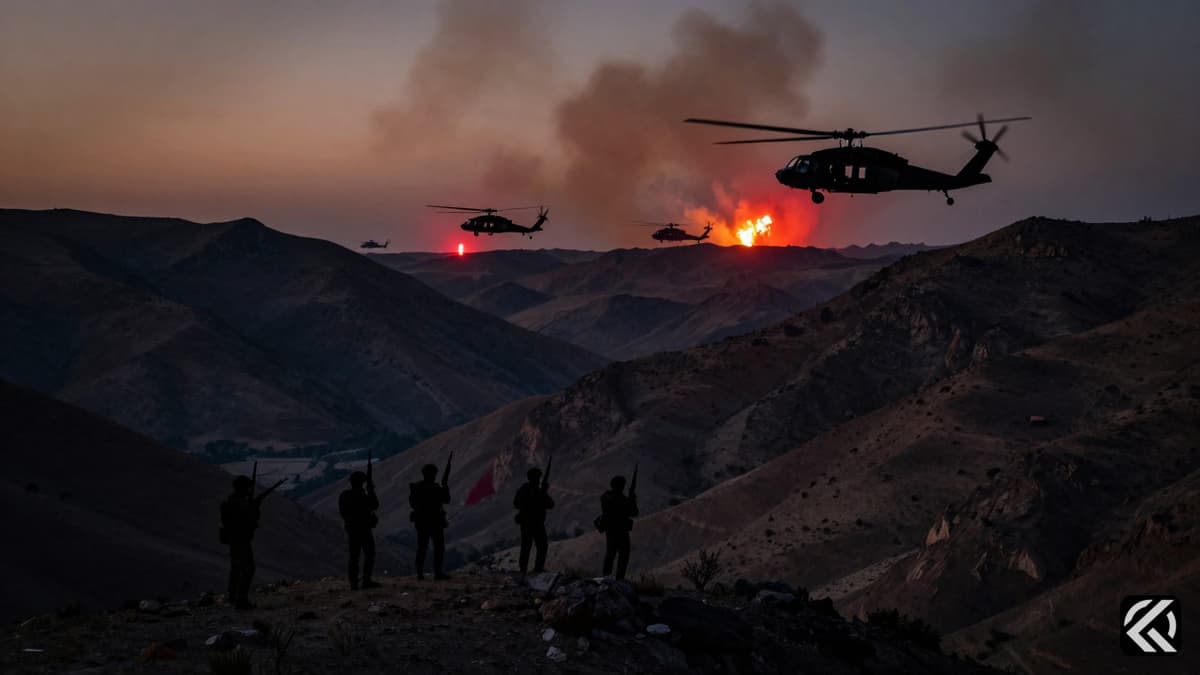
Amidst escalating tensions, Iran warns of hellish consequences as the US searches for an F-15 crew member. Trump issues threats, Israel confirms strikes, and global markets tremble.
International tensions have reached a critical boiling point as Iranian military officials warned the United States and Israel that they face the punishment of "hell" if the conflict expands. This severe warning echoes a threat made earlier in the day by US President Donald Trump, who had cautioned that unleashing "all Hell" on Iran would follow unless a deal to open the Strait of Hormuz is reached by Monday. The standoff is occurring against the backdrop of a desperate search operation for a second crew member from an F-15 fighter jet that was shot down over Iran on Friday. The situation has rapidly evolved from diplomatic threats to kinetic actions, with Iranian tribesmen reportedly shooting at American helicopters engaged in the search-and-rescue mission, and Israeli forces confirming attacks on critical infrastructure.
The atmosphere on the ground has become increasingly hostile for the recovery teams. State media reported that on Saturday, groups of Iranian tribesmen in the remote mountainous areas of the Kohgiluyeh and Boyer-Ahmad provinces and the Bakhtiari region opened fire on two Black Hawk helicopters. These attacks were part of a coordinated effort to intercept the search for the missing pilot. The Islamic Revolutionary Guard Corps (IRGC) commended the tribesmen for their role, describing them as "courageous, valiant and victorious guardians of the borders." Iran has also offered substantial cash rewards for the successful capture of the missing airman, indicating a determined strategy to hold the soldier. Experts, including Ravi Chaudhary, a former director of the Personnel Recovery Center, have noted that while the situation is dire, the silence from the Trump administration might be a tactical move to allow US Central Command "maximum opportunity and the minimal distraction" to conduct the recovery.
Simultaneously, the conflict has widened in scope, drawing in multiple actors and regions. The Israel Defense Forces (IDF) spokesperson Avichay Adraee stated that the Israeli military issued an evacuation order ahead of planned airstrikes, specifically citing the use of the Masnaa crossing by Hezbollah for smuggling weapons. This announcement led the Syrian Authority for Border Crossings and Customs to temporarily close the Masnaa crossing on the Syrian-Lebanese border, declaring it designated exclusively for civilian passage. Prime Minister Benjamin Netanyahu later confirmed that Israel did attack Iran's petrochemical plants, validating reports from Tehran that multiple companies had been damaged by the strikes. The impact of these Israeli strikes Iran has rippled across the region, with displaced Lebanese civilians now struggling to meet basic needs as a humanitarian emergency unfolds.
The repercussions of the Iran-US conflict extend far beyond the immediate battlefield and diplomatic exchanges. In a significant economic development, India's oil and natural gas ministry confirmed that the nation purchased oil from Iran for the first time in years, a move that roils global energy markets and signals a potential shift in regional trade dynamics. Domestically, the US economy faces uncertainty; while the latest jobs report showed an unexpected increase in employment last month, economists caution that the health of the labor market and the broader economy hinges heavily on the scope and duration of the ongoing war. The social fabric in Israel is also fraying, as police broke up an anti-war protest in Tel Aviv, dispersing hundreds and arresting at least 17 people who were defying a court order limiting the crowd size. The tension was compounded when a missile siren sounded during the dispersal, forcing even mounted police to seek shelter, highlighting the pervasive danger that now defines daily life for civilians in the region.
The convergence of military aggression, economic maneuvering, and internal dissent suggests a prolonged period of instability. As Iran continues to threaten the "gates of hell" and the US searches for its missing pilot, the probability of further escalation remains high. The involvement of tribal groups and the use of new aerial defense systems by the IRGC indicate a shift toward asymmetric warfare designed to complicate US recovery efforts and deter further strikes. Economically, the purchase of Iranian oil by India signals a potential decoupling of regional markets from Western pressure, which could alter global energy prices. Unless de-escalation occurs, the humanitarian crisis in Lebanon and the continued closing of critical border crossings like Masnaa will likely deepen the suffering of civilians and strain international diplomatic channels for the foreseeable future.
Jun 8, 2026 02:17 UTC
Magnitude 7.8 Quake Shakes Philippines, Urging Immediate Evacuations
Jun 8, 2026 00:51 UTC
Trump Claims Iran Nuclear Deal Imminent Despite Diplomatic Fractures
Jun 8, 2026 00:47 UTC
Iran Fires Missiles at Israel After Beirut Strike
Jun 7, 2026 22:00 UTC
US, Iran Peace Hops Fade 100 Days Into War
Jun 8, 2026 04:15 UTC
Trump Urges Netanyahu to Halt Iran Strike for Peace


