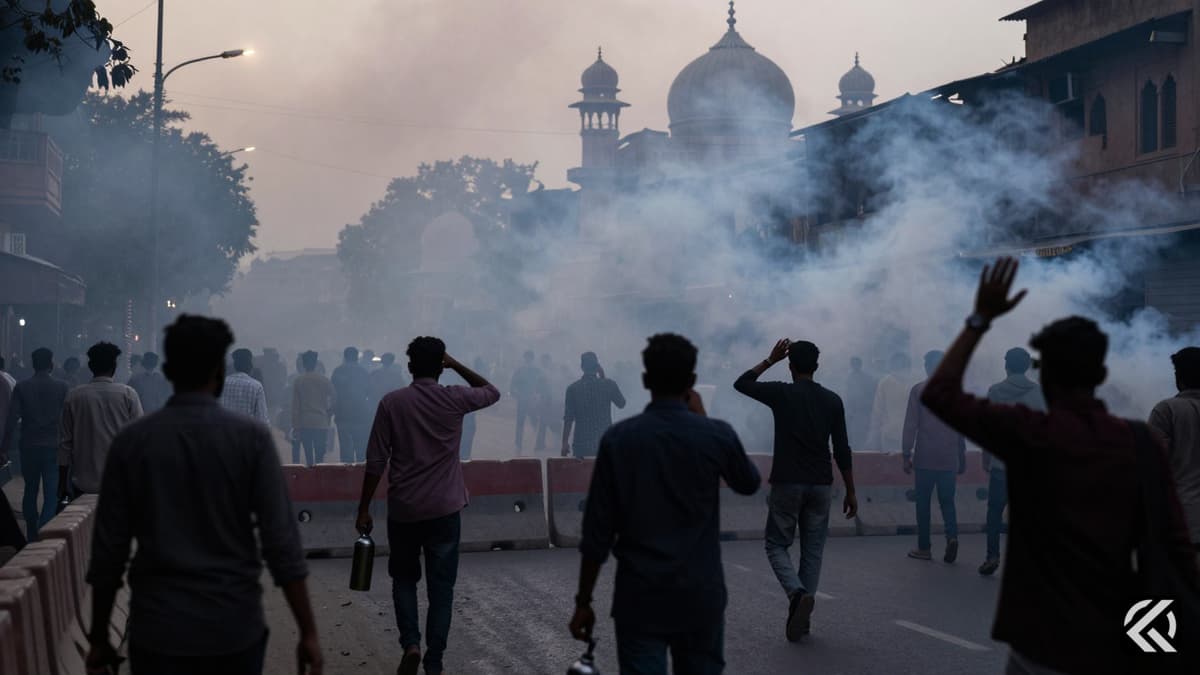
Deadliest clashes erupt in Rawalakot over legislative seat reservations, revealing deep governance grievances in Pakistan-administered Kashmir amid internet blackouts and legal rulings.
At least 11 people were killed on Sunday during violent clashes between police and protesters in Rawalakot, the capital of Poonch district in Pakistan-administered Kashmir. The fatalities occurred just days before a major demonstration organized by a banned civil society group, highlighting escalating tensions over political representation. Authorities had deployed federal paramilitary troops and issued strict travel advisories, but the protest proceeded despite the heavy security presence.
The unrest has drawn international attention due to the severity of the crackdown and the underlying political grievances. While the immediate trigger was a dispute over legislative seats, experts suggest the violence reflects deeper, long-standing issues regarding governance, resource allocation, and regional autonomy in the territory. The situation has led to a third day of severe internet restrictions and a judicial ruling that complicates the protesters' demands.
The core conflict stems from a controversial decision to reserve 12 seats in Pakistan-administered Kashmir’s legislature for refugees from Indian-administered Kashmir who now live in other parts of Pakistan. If these refugees reside in Pakistan-administered Kashmir, they are ineligible to contest for these specific reserved seats. The region is scheduled to vote on July 27 to elect its next legislature, which comprises 45 seats in total.
The JAAC, a grassroots umbrella organization led by activist Shaukat Nawaz Mir, initiated the protests against this arrangement. The group argues that all legislative seats must be allocated to those who actually reside in the region, rather than to constituencies scattered across Pakistan. This demand is part of a broader 38-point charter of demands released by the JAAC in late 2025, which also includes calls for economic subsidies, investigations into corruption, and improved social welfare infrastructure.
Abdul Jabbar Nasir, a journalist originally from the Gilgit Baltistan area, explained that these reserved seats have existed in various forms since the late 1940s and were formalized in the region's 1974 interim constitution. This constitution treats the area as a self-governing entity with its own prime minister, president, and courts, while defense and foreign affairs remain under Pakistan’s control. Nasir warned that abolishing these seats would weaken Pakistan’s diplomatic case for Kashmiri statehood at the United Nations and strengthen India’s position by suggesting both countries have "regularized" their control over their respective portions of the disputed region.
Tensions boiled over in Rawalakot on Sunday, where clashes left eleven people dead and more than 70 injured. Sardar Waheed Khan, the commissioner of the Poonch district, stated that four police officers and one passer-by were killed after being shot at, while six protesters died. Police Chief Liaqat Malik reported that 23 security officials and 50 protesters were among those injured. Khan described the events as an effort to restore law and order, denying allegations of a massacre.
In response to the unrest, local authorities issued an advisory urging visitors to leave the area by Friday evening to avoid "unpleasant situations." The government proscribed the JAAC under the Anti-Terrorism Act of 2014, claiming the group was engaged in terrorism and created anarchy by intimidating the public. Despite these restrictions, the JAAC proceeded with their planned protest, asserting that their actions were necessary to address systemic grievances.
Internet access in Pakistan-administered Kashmir remained severely restricted for a third consecutive day, according to data from the monitoring group NetBlocks. This blackout follows previous communications blackouts imposed by the government in response to JAAC-initiated lockouts in September and October 2025.
The legal landscape shifted on Sunday when the Supreme Court of Azad Jammu and Kashmir ruled that the 12 reserved seats are constitutionally protected. The court stated that abolishing the reservation would require a constitutional amendment, effectively closing the legal route for groups challenging the existing arrangement. This ruling intensified calls for protest, as highlighted by Raja Qaiser Ahmed of Quaid-i-Azam University, who noted that the crisis reflects a broader debate about governance and regional autonomy.
Previous negotiations between a federal ministerial team and JAAC leadership in late May failed to produce a breakthrough, leading to the current escalation. The protests have their roots in earlier discontent, including skyrocketing electricity bills and flour shortages that first sparked unrest in May 2023. Subsequent marches in May 2024 toward Muzaffarabad resulted in violent clashes that left at least five people dead, including a police officer.
The violence in Rawalakot and the subsequent government crackdown signal a critical juncture for political stability in the region. The intersection of legal protections for reserved seats with widespread public dissent creates a volatile environment. The continued internet blackout and deployment of paramilitary forces suggest the government’s determination to maintain control, potentially exacerbating local grievances.
If the constitutional status of the reserved seats remains unchallenged through legal means, the JAAC and other civil society groups may resort to further civil disobedience. The deep-seated issues regarding resource distribution and autonomy, encapsulated in the 38-point charter, remain unresolved. This standoff risks further destabilizing the region, complicating diplomatic narratives regarding Kashmir, and straining relations between the local administration and Islamabad. The coming months will be crucial in determining whether dialogue can resume or if the cycle of protest and suppression will continue to deepen.
Jun 9, 2026 20:58 UTC
Trump Demands U.S. Action as Iran Shoots Down Second Aircraft
Join 50,000+ readers getting the global briefing every morning.
No spam. Unsubscribe anytime.
Jun 9, 2026 18:37 UTC
Israel Strikes Tyre Despite Iranian Warnings
Jun 9, 2026 16:42 UTC
IAB Framework Data Practices and User Privacy Choices
Jun 9, 2026 16:07 UTC
Madhya Pradesh Congress Departs for Bengaluru to Avoid Rajya Sabha Elections Pitfalls
Jun 9, 2026 14:27 UTC
US Sea Drone Saves Army Helicopter Crew Near Strait of Hormuz


