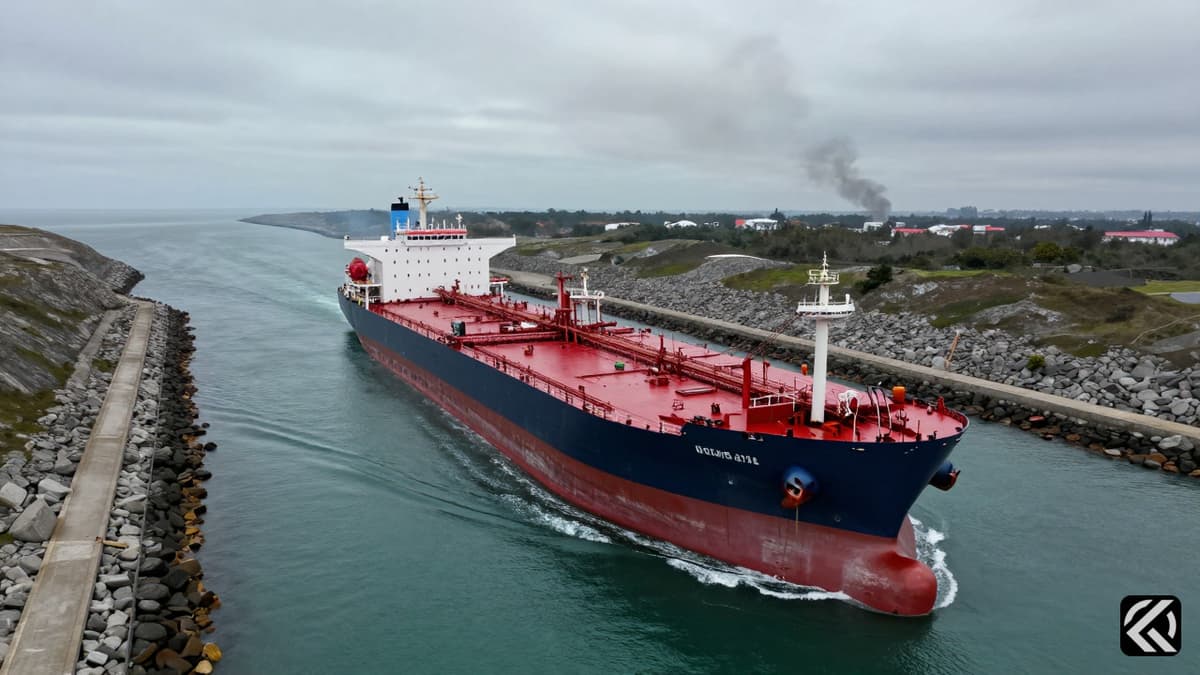
Global energy markets react sharply to renewed US military action against Iranian targets, raising fears that the vital shipping choke point remains unstable despite diplomatic efforts.
Global oil prices have surged following a new wave of US military strikes against Iran, targeting a military installation in the strategic port city of Bandar Abbas. The escalation has immediately impacted global energy markets, raising concerns about the stability of critical shipping lanes.
The US Central Command (Centcom) announced that its forces were engaged in active defense, successfully shooting down four Iranian drones that were perceived as a threat in the vicinity of the Strait of Hormuz. This military activity occurred even as diplomatic channels remained open, with Washington and Tehran holding discussions aimed at concluding a three-month-long conflict. That prolonged tension has effectively closed the key Strait of Hormuz waterway, a vital artery for global commerce, pushing up the cost of energy for consumers and industries worldwide.
The Strait of Hormuz remains one of the most critical choke points in the global energy supply chain. Approximately one-fifth of the world's total oil and liquefied natural gas (LNG) supplies typically pass through this narrow passage. Any disruption here has immediate and severe consequences for global supply chains. The latest violence marks the second time in just three days that the US has conducted attacks on targets within Iranian territory. Washington has defended these actions as necessary measures for self-defense, aiming to neutralize immediate threats to its military personnel.
Earlier in the week, Centcom had already confirmed strikes on southern Iran, which specifically targeted Iranian missile sites and naval boats attempting to lay mines in the strait. The command stated that these operations were designed "to protect our troops from threats posed by Iranian forces." This pattern of escalating kinetic activity complicates the diplomatic efforts currently underway. The conflict originally ignited shortly after the US and Israel launched airstrikes on Iran on February 28. In response to those initial attacks, Tehran threatened to target vessels utilizing the shipping route, setting the stage for the current blockade-like situation.
Global energy markets have experienced wild swings since the outbreak of hostilities. Brent crude, the global benchmark for oil, briefly surged to approximately $120 a barrel during the height of the tension. Prior to the war, the price was trading closer to $70 a barrel. The latest jump sees Brent rise by 3.75% to reach $97.83 (£73.15) per barrel, while US-traded crude also climbed 4% to $92.22. These figures highlight the market's sensitivity to geopolitical instability in the region.
Notably, the cost of oil had fallen sharply earlier in the current week. This dip was driven by investor hope that a diplomatic deal would soon be reached to reopen the Strait of Hormuz to unhindered shipping traffic. The renewed US attacks on Iran have shattered those hopes, causing prices to rebound sharply. The market reaction underscores the fragility of the current ceasefire negotiations and the difficulty of decoupling economic stability from military conflict in the region.
The juxtaposition of active military strikes and diplomatic talks creates a complex environment for future energy stability. While both nations are engaged in talks to end the conflict, the frequency of attacks suggests that trust is minimal and operational security remains paramount for US forces. The continued presence of Iranian forces attempting to lay mines, as confirmed by Centcom, indicates that Tehran continues to leverage its control over the waterway as a strategic asset.
Looking ahead, the long-term impact on global energy markets will depend heavily on the outcome of these negotiations. If the ceasefire holds and the Strait of Hormuz is reopened, prices may stabilize closer to pre-conflict levels, though likely remaining elevated due to risk premiums. However, if military exchanges continue or escalate, as seen in the recent three-day window, Strait of Hormuz trade could face prolonged disruption. This would likely keep oil prices volatile and high, influencing inflation rates and economic policies globally. The incident serves as a stark reminder of how regional conflicts in the Middle East continue to dictate global energy security. Ultimately, without a durable agreement that ensures free navigation, the region will remain a flashpoint for economic uncertainty, affecting not just the immediate belligerents but consumers worldwide who rely on steady energy supplies.
Jun 9, 2026 18:37 UTC
Israel Strikes Tyre Despite Iranian Warnings
Jun 9, 2026 14:27 UTC
US Sea Drone Saves Army Helicopter Crew Near Strait of Hormuz
Jun 9, 2026 04:31 UTC
India Condemns Pakistan’s ‘Fitna al Hindustan’ Narrative at UN
Jun 9, 2026 02:39 UTC
US Warplane Strikes Tanker MT Marivex; Crew Evacuated in Gulf of Oman
Jun 9, 2026 20:58 UTC
Trump Demands U.S. Action as Iran Shoots Down Second Aircraft


