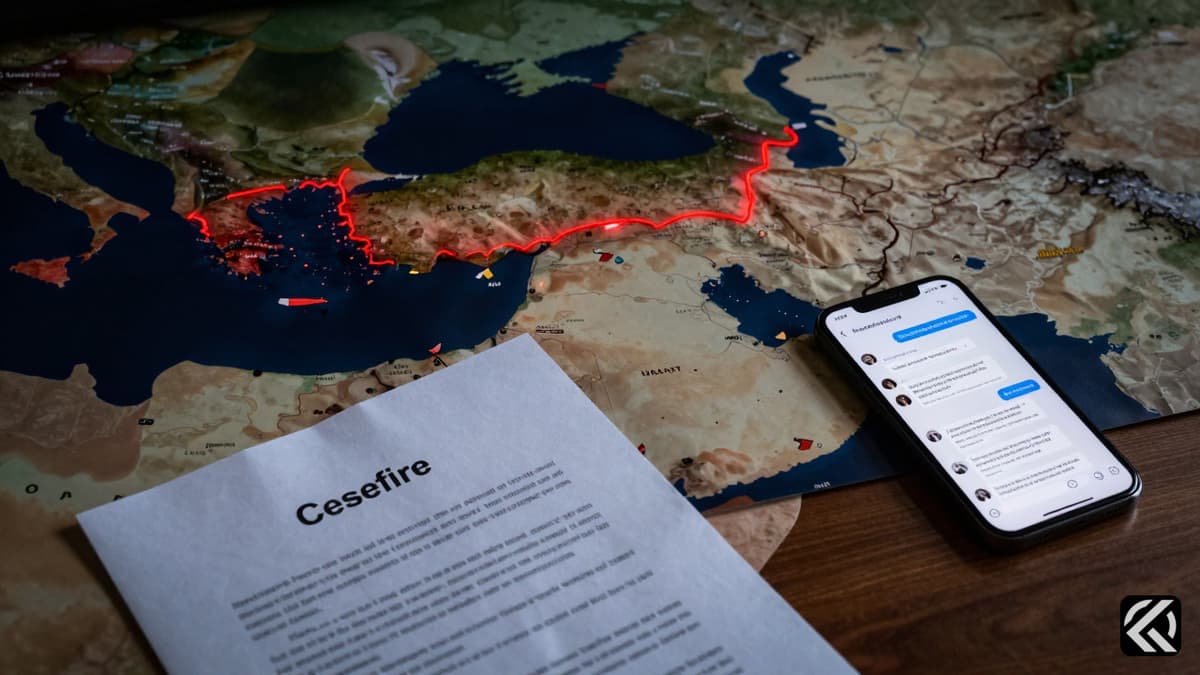
Tehran warns that continued Israeli aggression in Lebanon jeopardizes the fragile Iran-US ceasefire, even as US officials claim diplomatic progress is underway.
The geopolitical landscape in the Middle East is facing a critical juncture as Tehran officially warns that ongoing Israeli strikes in Beirut are directly jeopardizing the fragile truce between Tehran and Washington. This warning comes in the immediate aftermath of Israeli Prime Minister Benjamin Netanyahu ordering military operations against Hezbollah targets in the southern suburbs of the Lebanese capital. Iranian Foreign Minister Abbas Araghchi has drawn a hard line, asserting that the agreement with the United States is "unequivocally a ceasefire on all fronts, including in Lebanon." He emphasized the interconnected nature of the conflict, stating that "its violation on one front is a violation of the ceasefire on all fronts," thereby linking the fate of the broader US-Iran deal directly to the violence on the ground in Lebanon.
Amidst these escalating tensions, US President Donald Trump has attempted to project an image of diplomatic resolution through aggressive communication on social media. Insisting that negotiations with Iran are proceeding at a "rapid pace," Trump detailed conversations with key regional actors. He claimed to have had a "very productive call" with Prime Minister Netanyahu, asserting that "there will be no Troops going to Beirut, and any Troops that are on their way, have already been turned back." Simultaneously, Trump described his interaction with Hezbollah representatives as "very good," citing an agreement that "all shooting will stop" and that mutual non-aggression would be maintained. However, he also issued a stark warning on X (formerly Twitter), stating that if Hezbollah continues to attack Israeli cities and civilians, Israel would retain the right to strike terrorist targets in Beirut.
The official response from Lebanon’s presidential office adds a layer of diplomatic confirmation to these complex maneuvers. The office stated that Lebanese authorities had "received confirmation of Hezbollah's acceptance of the US proposal for a mutual cessation of attacks." This proposal outlines a specific framework: Israeli strikes on Beirut's southern suburbs would cease in exchange for Hezbollah refraining from attacks against Israel. Crucially, this arrangement is intended to extend the ceasefire to encompass all Lebanese territory, suggesting a broader de-escalation strategy that Lebanon’s leadership appears to be actively supporting.
Despite these claims of progress, the reality on the ground tells a different story. Iranian-aligned news agency Tasnim, affiliated with the Islamic Revolutionary Guard Corps (IRGC), reported that Iran and its allies are prepared to "activate other fronts, including the Bab al-Mandab Strait" at the entrance of the Red Sea. While Iranian authorities have not publicly commented directly on this specific report, state television indicated that the probability of the Iran-US ceasefire ending is high if Israel does not end its offensive in Lebanon. This suggests that Tehran views the violence in Beirut not as an isolated incident, but as a potential prelude to a wider regional conflict that could unravel diplomatic efforts entirely.
The current truce between the US and Iran officially came into force on April 8, yet it has fundamentally failed to end the fighting. The United States has attempted to decouple the events in Lebanon from its broader negotiations with Iran. Historically, Washington has insisted that any agreement must include peace in Lebanon, recognizing Iran's role as a significant ideological, military, and financial backer of Hezbollah. This strategic link means that instability in Beirut is viewed in Washington as a direct threat to the stability of the wider US-Iran deal.
Recent diplomatic efforts have included Secretary of State Marco Rubio proposing a plan for "gradual de-escalation" to both Netanyahu and Lebanese President Joseph Aoun on Sunday. The Israeli military has struck Beirut twice since the ceasefire between Israel and Lebanon took effect on April 16, with the most recent attack occurring on Thursday. While these strikes represent a reduction in frequency compared to previous escalations, they remain a point of contention. Reports indicate that the White House has been actively pressuring Israel to limit its military action in Beirut to avoid jeopardizing efforts to strike a broader deal that would end the war involving the US, Israel, and Iran.
Tensions have also spilled over into the Strait of Hormuz over the weekend. The US announced it hit Iranian military sites, while Tehran claimed it responded by targeting a US base in Kuwait. This military exchange had immediate economic repercussions. The price of oil rose sharply on Monday, with Brent crude jumping almost $5 (£3.7) a barrel to $97.44 (£72.45). This financial impact underscores the volatility of the region and the potential for geopolitical instability to translate into global economic shockwaves.
The immediate surge in oil prices and the conflicting signals from US, Iranian, and Israeli leaders suggest that the region is teetering on the edge of a broader conflict. If Israel continues its Israeli strikes in Beirut despite White House pressure, the Iran-US ceasefire remains highly vulnerable to collapse. The activation of secondary fronts, such as the Bab al-Mandab Strait, as threatened by Iranian-aligned entities, could further destabilize global energy markets. The success of the current diplomatic efforts hinges entirely on Israel's willingness to halt operations in Lebanon and Hezbollah's adherence to the cessation of attacks. Failure to adhere to these mutual restrictions will likely result in the unraveling of the April 8 truce, leading to prolonged regional warfare and sustained economic volatility.
Jun 9, 2026 18:37 UTC
Israel Strikes Tyre Despite Iranian Warnings
Jun 9, 2026 14:27 UTC
US Sea Drone Saves Army Helicopter Crew Near Strait of Hormuz
Jun 9, 2026 04:31 UTC
India Condemns Pakistan’s ‘Fitna al Hindustan’ Narrative at UN
Jun 9, 2026 02:39 UTC
US Warplane Strikes Tanker MT Marivex; Crew Evacuated in Gulf of Oman
Jun 9, 2026 20:58 UTC
Trump Demands U.S. Action as Iran Shoots Down Second Aircraft


