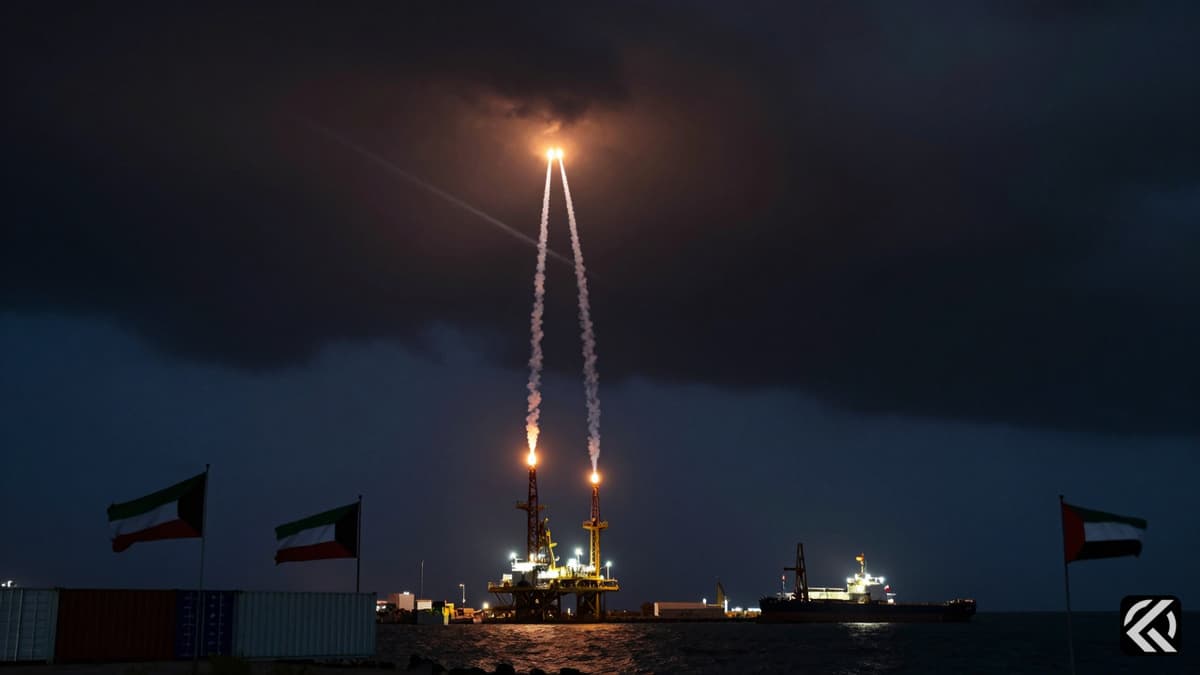
Iran launches missile strikes on Kuwait and Bahrain, prompting the UAE to demand a unified Gulf response as oil prices surge and peace talks face severe disruption.
Early Wednesday, a severe escalation in regional hostilities occurred when Iranian missiles and drones targeted Bahrain and Kuwait. Tehran justified these strikes as a direct response to recent US military actions against coastal installations within Iran. This exchange marks one of the most significant nights of combat since a ceasefire was purportedly established in April, raising fears that diplomatic efforts are unraveling.
The United Arab Emirates has swiftly called for a unified response from Gulf nations, arguing that the security of Arab Gulf states is interconnected. Anwar Gargash, an adviser to the UAE presidency, emphasized that no Gulf state should be left to face such targeting alone. In a post on X, Gargash stated, "This aggression does not target a specific state, but rather all of us," urging a firm, cohesive stance against what he described as repeated Iranian aggression.
Kuwait’s Foreign Ministry reported that an Iranian strike aimed at its international airport killed one person and injured others. Video footage released showed extensive damage inside a passenger terminal. Meanwhile, Bahrain reported that it successfully intercepted three Iranian missiles and multiple drones. The conflict has also threatened vital energy infrastructure, with the UAE’s Barakah Nuclear Power Plant coming under fire last month in what the IAEA described as a "very carefully targeted operation."
The economic repercussions of this escalating violence are already being felt globally. Oil prices are climbing as traders fret that the conflict could drag on, threatening to derail ongoing peace talks and prolong disruption to oil flows through the Strait of Hormuz. Brent crude, the global oil benchmark, rose 2.6% to $98.50 a barrel on Wednesday. West Texas Intermediate, the US benchmark, climbed 2.8% to $96.34 a barrel. This marks a significant jump, with Brent now more than $7 higher than its closing price on Friday.
Despite the spike in energy costs, US equity futures remained mixed, while Europe’s major stock indexes traded lower. In Asia, Japan’s Nikkei closed 2.5% higher, driven by optimism over artificial intelligence and new government stimulus announcements. However, the Organisation for Economic Cooperation and Development (OECD) has issued a stark warning: global economic growth could slow to levels seen during the Covid-19 pandemic and the global financial crisis if the war persists.
The OECD’s latest global economic outlook suggests that a "prolonged disruption" to energy flows from the Middle East extending into 2027 would see global growth slow to 2.1% in 2026 and 1.8% in 2027. These rates are described as "extremely low" outside of major global recessions. The OECD warned that such a scenario would leave a "lasting mark on many countries, especially in Asia." If the conflict is resolved more quickly, growth is expected to slow from 3.4% in 2025 to 2.8% in 2026 before recovering to 3.1% in 2027.
The military exchanges between the US and Iran have intensified significantly. US Central Command (CENTCOM) stated that the US military used a Hellfire missile to hit a Botswana-flagged oil tanker heading toward an Iranian port on Kharg Island because the ship did not comply with the US blockade. In response, Iran said it fired missiles at a Liberian-flagged vessel.
The situation escalated further after the US struck an Iranian military ground control station on Qeshm Island, near the Strait of Hormuz. Iran responded by firing missiles and drones at the Gulf nations of Kuwait and Bahrain, claiming to have targeted an American air and helicopter base as well as the US Fifth Fleet headquarters in Bahrain. The US military rejected these claims, stating that "all Iranian attacks on American forces failed," noting that the missiles and drones were either intercepted or fell short of their targets.
Diplomatic efforts remain fragile. Iranian media outlets have signaled that talks between Tehran and Washington are ongoing. US President Donald Trump told ABC News that he believes a deal to reopen the Strait of Hormuz and extend the ceasefire with Iran is reachable "over the next week." However, the ceasefire is on precarious footing, with Iran previously suspending talks and threatening escalation if Israel’s attacks on Lebanon continue. Trump has pressed Israel to scale back its Lebanon offensive, with further talks expected on Wednesday.
The UAE has consistently argued for a tougher collective response by members of the Gulf Cooperation Council. Sultan Al-Nuaimi, Director General of the Emirates Center for Strategic Studies and Research (ECSSR), wrote on X that there is "enough with the condemning statements" without a firm stance. He argued for dialogue and diplomatic solutions "from a position of strength, not appeasement that the Iranian regime interprets as weakness."
Qatar’s Foreign Ministry also affirmed the region’s "total rejection of targeting civilian objects and vital facilities," emphasizing that the region must be spared from the consequences of unjustified attacks. Meanwhile, the IAEA’s Rafael Grossi noted that there is currently "very limited" activity in Iran regarding uranium enrichment, though it remains unclear when this might restart. He described the recent drone attack on the Barakah plant as deliberately carried out to affect operations, though authorities reported no injuries and no impact on radiological safety levels.
Global implications extend beyond immediate energy costs. Cormann highlighted that the current spike in fertilizer prices due to reduced flows through the Strait of Hormuz could send wheat prices up by 13% if sustained. "This is not an abstract risk, it is a very real food security risk and it will fall hardest on the most vulnerable economies," he said, underscoring the broader humanitarian and economic dangers of the prolonged instability.
The current trajectory of conflict between Iran, the US, and their respective regional allies presents a critical juncture for international stability. The immediate surge in oil prices and the targeted strikes on civilian and infrastructure assets in Kuwait and Bahrain indicate a high risk of further escalation. If diplomatic interventions fail to secure a durable ceasefire, the OECD’s prediction of severe global economic slowdowns becomes increasingly likely. Long-term impacts will hinge on the UAE’s ability to rally a unified Gulf defensive posture and the effectiveness of US-led negotiations to restore safe passage through the Strait of Hormuz, which remains vital for global energy markets and food security.
Jun 9, 2026 20:58 UTC
Trump Demands U.S. Action as Iran Shoots Down Second Aircraft
Join 50,000+ readers getting the global briefing every morning.
No spam. Unsubscribe anytime.
Jun 9, 2026 18:37 UTC
Israel Strikes Tyre Despite Iranian Warnings
Jun 9, 2026 16:42 UTC
IAB Framework Data Practices and User Privacy Choices
Jun 9, 2026 16:07 UTC
Madhya Pradesh Congress Departs for Bengaluru to Avoid Rajya Sabha Elections Pitfalls
Jun 9, 2026 14:27 UTC
US Sea Drone Saves Army Helicopter Crew Near Strait of Hormuz


