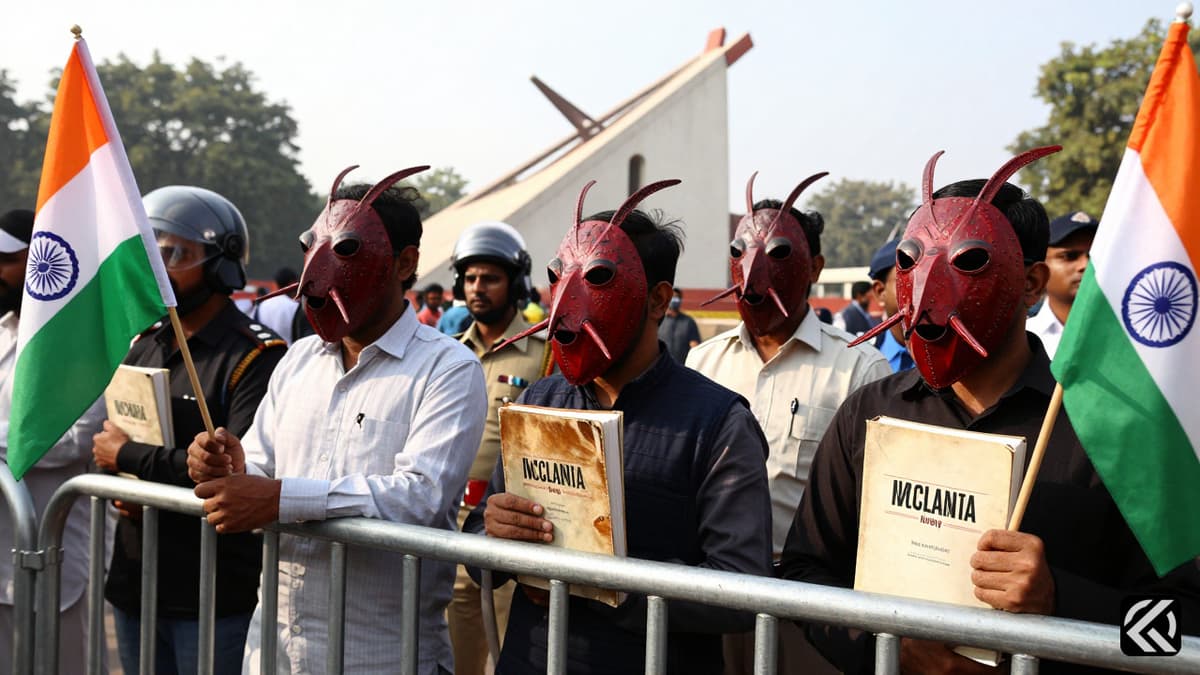
Hundreds of young protesters in New Delhi donned cockroach masks to demand accountability for exam failures, signaling a shift from online satire to political action.
At New Delhi’s Jantar Mantar, a historic protest site, hundreds of young demonstrators gathered to transform digital satire into a tangible political force. Wearing cockroach masks and clutching dog-eared exam guides, they signaled a departure from online jokes to real-world dissent. This demonstration was driven by severe discontent regarding academic integrity and future prospects.
The group identifies as the Cockroach Janta Party, a satirical entity born less than three weeks ago. Its creation was a direct response to India’s chief justice likening government critics and unemployed youth to “cockroaches” and “parasites.” What started as a parody account on social media has rapidly evolved into a channel for expressing anger over failing exams, job scarcity, and a crumbling economic promise.
On Saturday, this digital discontent materialized physically. Protesters waved India’s national flag and held schoolbooks, demanding the resignation of Education Minister Dharmendra Pradhan. Their demand stems from a series of severe incidents, including exam paper leaks, technical glitches, and cancelled tests. The fiasco surrounding the NEET exam has become a symbol for many, representing a system that has lost its credibility in the eyes of young Indians. Reports of student suicides linked to these failures have further intensified the public outrage.
The rally was led by the party’s founder, 30-year-old political strategist Abhijeet Dipke. A graduate of Boston University, Dipke flew in from the United States to guide the supporters. During the event, he told the crowd that “cockroaches don’t ever fear,” reinforcing the group’s defiant stance. The presence of police in riot gear and steel barricades underscored the risks associated with such dissent in an era where large protests often face crackdowns and criminal cases.
The scale of the movement is significant. With more than 20 million followers on Instagram, the group has already outgrown many mainstream parties in the online sphere. This massive digital presence allowed the initial meme factory to explode into a nationwide phenomenon, capturing the attention of the anxious, hyper-connected youth demographic.
The Saturday protest serves as a critical test for the organization. It will determine whether self-deprecating memes and satire can be successfully converted into a lasting political organization. Furthermore, it questions whether India’s frustrated youth can establish a new political language to articulate their grievances effectively. The transition from digital anger to physical protest marks a pivotal moment for youth activism in India.
The evolution of the Cockroach Janta Party illustrates a broader trend in contemporary activism where online identity fuels offline mobilization. The group’s rapid growth from a joke to a serious political force suggests a deep-seated frustration that mainstream channels have failed to address. The specific targeting of the education minister highlights the direct link young people make between academic failures and their broader economic future.
The involvement of a founder with an international educational background adds a unique dimension to the protest. It suggests a cross-border perspective on the issues, potentially drawing attention from international observers. However, the core of the movement remains firmly rooted in local grievances regarding the NEET exam and the perceived lack of accountability from government officials.
The heavy security presence indicates that authorities view the protest as a significant potential disruption. The use of steel barricades and riot gear serves as a deterrent, but it also highlights the tension between the state and the emerging youth voice. The group’s resilience, embodied by the cockroach metaphor, suggests they are prepared to withstand such pressures.
The impact of this rally extends beyond the immediate demand for resignation. It represents a challenge to the established political narrative, which has often ignored or mocked youth dissatisfaction. By adopting the derogatory term as a badge of honor, the protesters reclaim their narrative and force the public to confront the severity of the educational crisis.
The Cockroach Janta Party’s rally at Jantar Mantar marks a decisive moment in Indian youth politics. By moving from online satire to physical protest, the group challenges the government’s handling of the NEET exam and broader educational integrity. The demand for Education Minister Dharmendra Pradhan’s resignation highlights the severity of the crisis. As digital discontent turns into organized action, the movement’s longevity depends on sustaining this momentum. If the youth continue to unify, this could force significant policy changes and accountability measures in the education sector, fundamentally altering the political landscape for future generations.
Jun 9, 2026 02:39 UTC
US Warplane Strikes Tanker MT Marivex; Crew Evacuated in Gulf of Oman
Join 50,000+ readers getting the global briefing every morning.
No spam. Unsubscribe anytime.
Jun 9, 2026 00:00 UTC
INDIA Bloc Leaders Gather in Delhi to Forge Strategic Unity
Jun 8, 2026 22:55 UTC
Netanyahu Vows Forceful Response to Future Iran Attacks
Jun 8, 2026 20:56 UTC
Netanyahu Halts Iran Fighting, Vows Future Force
Jun 8, 2026 20:54 UTC
Justice Department Moves to Strip Citizenship from 17 Individuals


